



In medicine, quality is not measured by response alone.
Measured by what supports it.
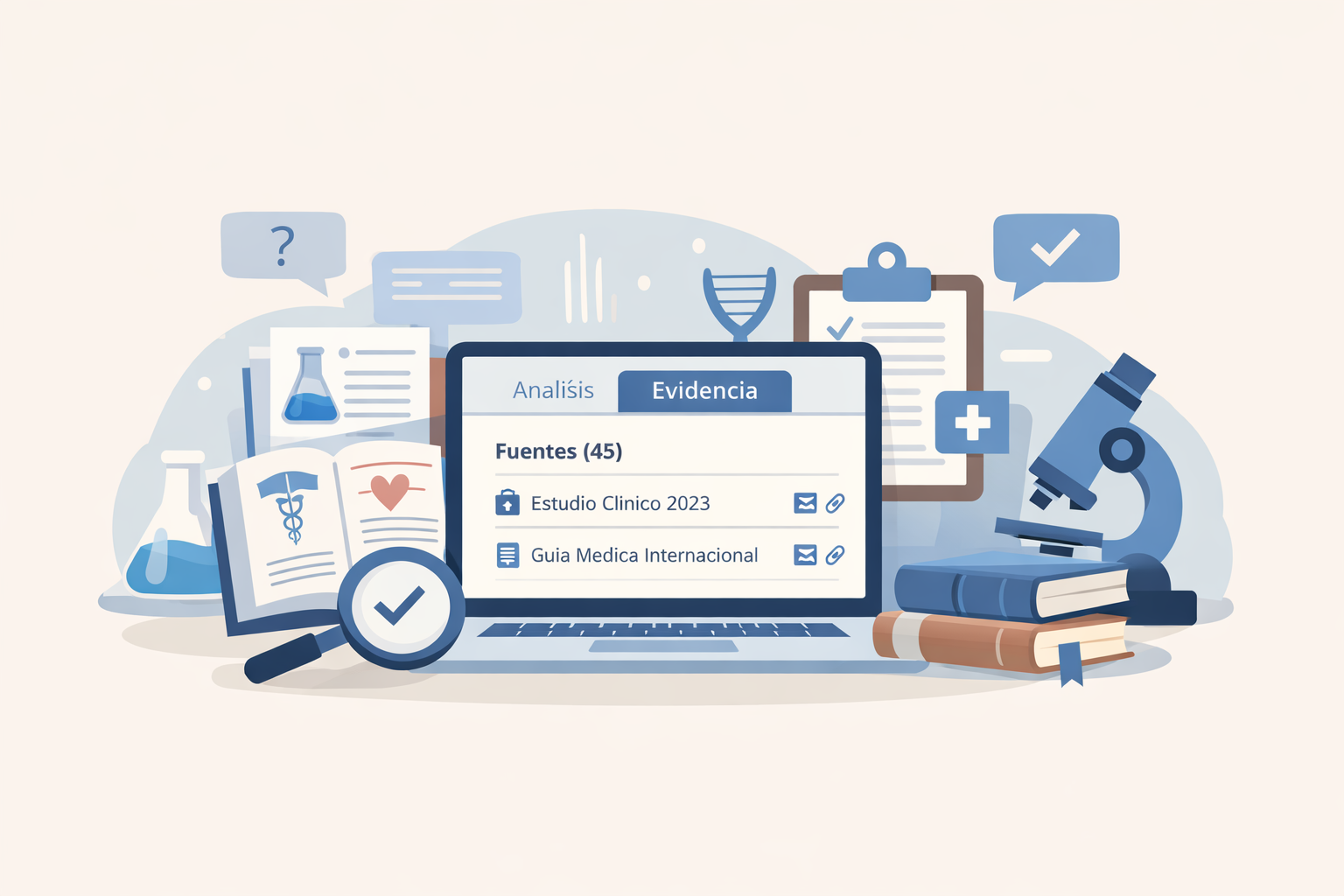
Therefore, in addition to improving the depth and accuracy of Deep Research, we are now adding a new tab:
Evidence
In each consultation of Deep Research, you can review:
- 📚 Complete list of sources used.
- 🔗 Direct links to primary articles.
- 📅 Date of publication
- ✂️ Extract from the relevant excerpt supporting the assertion
Real example:

This allows for quick verification:
- If the statement comes from a formal guide
- If the evidence is recent
- Whether consensus, trial or review
- If there is a subsequent update
What does Deep Research 2.0 improve?
1️⃣ More reliable
- Greater factual accuracy
- Less assertions without clear support
- Better alignment between text and quoted source
2️⃣ More complete
- Greater analytical depth
- Improved coverage of clinical scenarios and limitations
- Less superficial responses
3️⃣ Stronger citation
- Better anchoring to primary sources
- Increased consistency between statements and references
- Better consistency between online quotations and final list
4️⃣ Better performance in complex real-world tasks
Improvements are most noticeable in:
- Comparison between guides
- Multi-study synthesis
- Dispute analysis
- Evaluation of therapeutic trade-offs
- Clinical questions with multiple comorbidities
5️⃣ Best quality-speed balance
Greater depth without unduly penalizing response time.
6️⃣ Evaluated with real benchmark (DRACO)
The models that form the basis of Deep Research 2.0 were evaluated with DRACO (Deep Research Assessment in Complex Online environments), a benchmark designed to measure performance in real research tasks.
- Academic paper: https://arxiv.org/abs/2602.11685
This means that the improvement was measured in scenarios close to how you actually research.
What does it mean for each profile?
👨⚕️ Medical student
- Faster structured understanding
- Better conceptual integration
- Easily inspectable fonts in the Evidence
- Greater clarity on which study supports each claim
You don't just see the bottom line.
You can trace the path back to the original article.
🩺 Clinician under pressure
- Increased confidence in cited claims
- Cleaner and more consistent answers
- Less need to manually check each reference
- Immediate transparency in the tab Evidence
When time is limited, clarity matters.
🎓 Academic / Researcher
- Best cross-sectional synthesis
- Greater consistency between evidence and narrative
- Cleaner mapping between claims and references
- Structured list of sources in the Evidence
Less friction in literature review.
More rigor in comparative analysis.
What changes in daily practice?
- Less time auditing the response
- Increased confidence when teaching or discussing cases
- Better support for complex decisions
- Visible and verifiable evidence in one place
Deep Research 2.0 does not replace your clinical judgment.
It backs it up with better evidence, better organized - and now more transparent than ever.
If you are already using Itaca, try Deep Research 2.0 with a complex question and check the tab Evidence.
The difference is noticeable when the question really matters.


Leave a Reply