



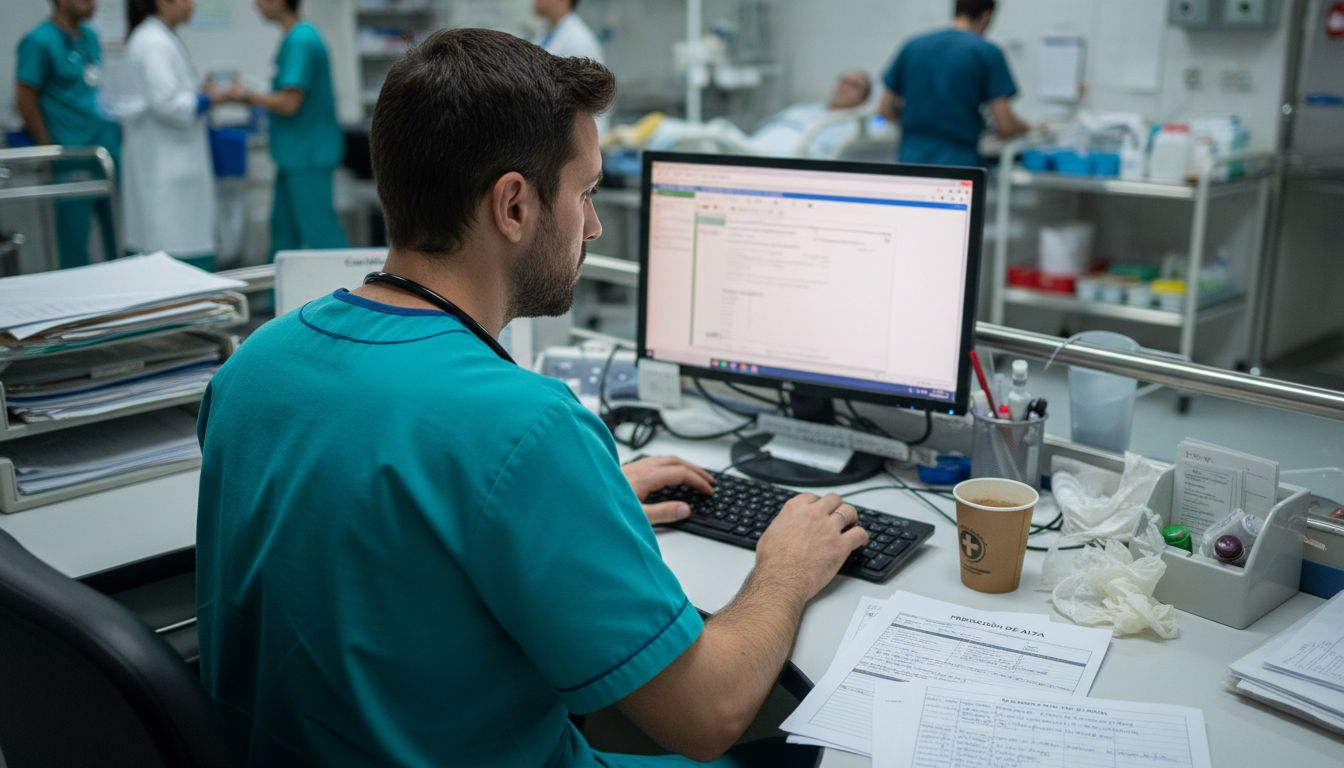
Up to 80%% of errors in emergency clinical notes are due to documentation failures. This reality directly impacts patient safety and the efficiency of the medical team. Optimizing the drafting of emergency notes not only reduces legal risks but also speeds up decision-making when every minute counts. Here you will discover practical methods for creating clear, fast, and safe medical records, leveraging technology and systematized processes.
Table of Contents
- Step 1: Prepare custom and automated templates
- Step 2: Systematically collect key information
- Step 3: Use digital tools to streamline writing
- Step 4: Verify accuracy and consistency before saving
- Step 5: Ensure traceability of each clinical decision
Quick Summary
| Key Point | Explanation |
|---|---|
| 1. Create custom templates | Templates optimize documentation time and ensure quality in medical notes. |
| 2. Systematic data collection | Implementing a triage system is essential for quickly capturing critical information. |
| 3. Use digital tools | Technological tools facilitate the quick and accurate writing of clinical notes. |
| 4. Check grades before saving | Meticulous review ensures the accuracy and consistency of the collected information. |
| Ensure clinical traceability | Documenting clinical decisions ensures transparency and more effective patient monitoring. |
Step 1: Prepare custom and automated templates
Creating custom templates for emergency medical notes can significantly optimize your documentation time. The goal is to develop predefined structures that can be quickly adapted to different clinical scenarios without sacrificing the quality and accuracy of information.
To begin, identify the fundamental elements that must be present in every emergency note. This includes the reason for consultation, relevant history, physical examination, diagnostic impression, treatment plan, and follow-up. When using tools such as personalized note templates, you'll be able to configure base structures that automatically adapt to your work style and specialty.
The process involves selecting essential fields and defining their order and format. Some specialties, like emergencies, require greater agility, so it's crucial to create templates that allow for the quick and systematic capture of critical information. Consider including sections for vital signs, assessment scales, time intervals, and spaces for specific observations.
Pro Tip: Test different template versions and adjust them based on your feedback. Don't be afraid to modify the initial structure until you find the format that optimizes your productivity without compromising documentation quality.
Step 2: Systematically collect key information
Systematic information gathering is fundamental to ensuring accurate and complete medical records in the emergency department. Your goal will be to develop a structured method that captures essential patient details quickly and efficiently.
The first step is to implement a system of Triage that optimizes information collection, allowing you to strategically classify and prioritize clinical data. This approach involves establishing a logical order for capturing critical elements: vital signs, chief complaint, relevant history, current symptomatology, physical examination, and initial diagnostic impressions. The key is to create a flow that enables you to obtain the most relevant information in the shortest possible time.
During data collection, maintain a methodical approach that combines speed with accuracy. Use predefined formats to guide your documentation process, ensuring you record not only objective findings but also qualitative observations that may be significant for diagnosis and treatment. Systematic documentation not only improves care quality but also facilitates communication among healthcare professionals.

Pro tip: Develop a system of personal abbreviations and annotations that allows you to document complex information quickly and in a standardized way, without losing the essence of clinical findings.
Step 3: Use digital tools to streamline writing
Digital tools have become fundamental allies for optimizing medical documentation in emergency settings. Your objective will be to identify and master technological solutions that allow you to generate accurate and efficient clinical notes without sacrificing the quality of information.
A key strategy is to implement Artificial intelligence platforms for automatic clinical note generation, which can capture essential patient information in real time. These tools will help you structure documentation quickly, allowing you to focus on the most critical aspects of medical care. Current technology allows for the customization of record formats to your specific needs, significantly reducing the time spent on manual transcription.
When integrating digital tools into your workflow, it's essential to maintain a balance between technological efficiency and your professional judgment. Select platforms that offer flexibility for editing and verifying generated information, ensuring each note accurately reflects your clinical assessment. The key is to consider these tools as support that enhances your documentation capabilities, not as a replacement for your medical judgment.
Pro Tip: Spend time getting familiar with digital tools before fully implementing them. Conduct gradual testing and adjust settings to ensure they perfectly suit your workflow and specialization.
Below is a comparison table of recommended digital tools to streamline clinical note writing:
| Digital tool | Main advantage | Key consideration |
|---|---|---|
| Custom templates | Quick adaptation to each patient | Requires prior configuration |
| Artificial intelligence (AI) | Automatic note generation | Review possible transcription errors |
| Electronic medical records | Centralized and secure logging | It depends on access and training |
| Voice dictation systems | Fast, touchless documentation | Needs a quiet environment |
Step 4: Verify accuracy and consistency before saving
The final review of your clinical notes is a critical step that ensures the quality and accuracy of medical documentation. Your goal will be to develop a systematic review method that captures any potential errors or inconsistencies before definitively recording the information.

The verification process requires a meticulous and structured approach. It begins with a thorough and detailed reading of the note, comparing the recorded information with the original data collected during patient care. Pay close attention to details such as names, dates, vital signs, medications, and clinical findings. Ensure that each section accurately reflects your assessment and the interventions performed, making sure there are no contradictions or incomplete information that could lead to confusion in future consultations.
In addition to the technical review, consider the overall clinical context of the note. Ensure the writing is clear, concise, and professional, using precise medical terminology and avoiding ambiguity. If you have used artificial intelligence tools or digital documentation systems, take extra time to confirm that automatic transcription has not introduced errors or misinterpretations that could compromise the quality of your record.
Pro Tip: Develop a personal checklist with critical points you should always review before saving any clinical note. This strategy will help you maintain a consistent standard of quality in your documentation.
Step 5: Ensure traceability of each clinical decision
Clinical traceability is fundamental to ensure the quality and accountability of your medical practice. Your goal will be to document each decision transparently and in detail, allowing for an accurate reconstruction of clinical reasoning and interventions performed.
An effective method involves recording Complete information in the electronic health record, documenting not only the results but also the thought process that led you to each conclusion. Include the context of your decisions with clear notes on physical findings, interpretation of tests, differential diagnoses, and the rationale that supported your treatment plan. Each entry should reflect a chronological and logical record that allows other professionals to understand your reasoning.
To maintain robust traceability, it is crucial to record any changes or adjustments to the treatment plan, explaining the reasons for the modification. Document consultations with specialists, interconsultation results, patient reactions to previous treatments, and any factors influencing your clinical decision. Transparency in record-keeping not only protects your professional practice but also contributes to safer and continuous medical care.
Pro Tip: Develop a habit of writing your notes immediately after each interaction while the details are still fresh in your memory. Immediacy ensures the accuracy and completeness of your documentation.
Here is a summary table of critical steps to ensure traceability in clinical documentation:
| Key step | Main objective | Impact on medical practice |
|---|---|---|
| Document clinical reasoning | Explain decisions and justifications | Improve transparency and legal backing |
| Record treatment changes | Maintain a timeline of adjustments in therapy | Facilitate continuity and quality of care |
| Include queries and cross-queries | Reflect on the contributions of other professionals | Foster interdisciplinary work |
| Describe response to interventions | Evaluate effectiveness and guide future decisions | Optimize clinical outcomes |
Optimize your emergency room clinical notes and reclaim your time for what matters
Creating quick and comprehensive medical notes in the emergency room without sacrificing quality can be a constant challenge. Often, the process consumes valuable time and generates stress due to the need for accurate documentation while attending to patients in critical situations. This article addresses how to create personalized templates, systematically collect key information, and ensure traceability in every clinical decision to improve your productivity and the quality of your documentation.
If you want to take these strategies to the next level and eliminate the administrative burden, find out how Itaca It can transform your day-to-day. Our artificial intelligence platform is designed for healthcare professionals who need to automate visit transcription, generate structured clinical notes, and improve traceability without changing their workflow. With Itaca, you'll gain more time for your patients and the peace of mind that comes with accurate and complete records.

Don't wait any longer to experience the efficiency you deserve. Explore New Functionalities dedicated to advanced clinical documentation and consult our Practical Tips to make the most of your time and enhance the quality of your work. Visit Itaca now and start optimizing your medical notes today.
FAQ
How can I prepare custom templates for emergency medical notes?
To prepare custom templates, identify the key elements that should be included, such as the chief complaint and relevant history. Then, create predefined structures that fit your workflow, allowing you to document quickly in an emergency setting.
What steps should I follow to systematically collect key information in the emergency department?
Implement a triage system to classify and prioritize clinical data. Ensure you record vital signs, reason for consultation, and physical examination, maintaining a logical order that facilitates the capture of fundamental information in minimal time.
What digital tools are effective for streamlining clinical note writing?
Utilize artificial intelligence platforms that allow for automatic note generation. These tools can help you structure documentation quickly, reducing manual transcription time.
How can I verify the accuracy and consistency of my notes before saving them?
Perform a detailed review of each note, comparing the information with the original data collected. Ensure there are no contradictions or incomplete information, using a personal checklist to maintain a high standard in your documentation.
Why is it important to ensure the traceability of each clinical decision?
Traceability allows for the transparent documentation of every decision, facilitating the reconstruction of clinical reasoning. It records the rationale behind each treatment plan to improve continuity of care and protect your professional practice.
Leave a Reply