



Clinical history format: download the PDF or Word file and see a complete example
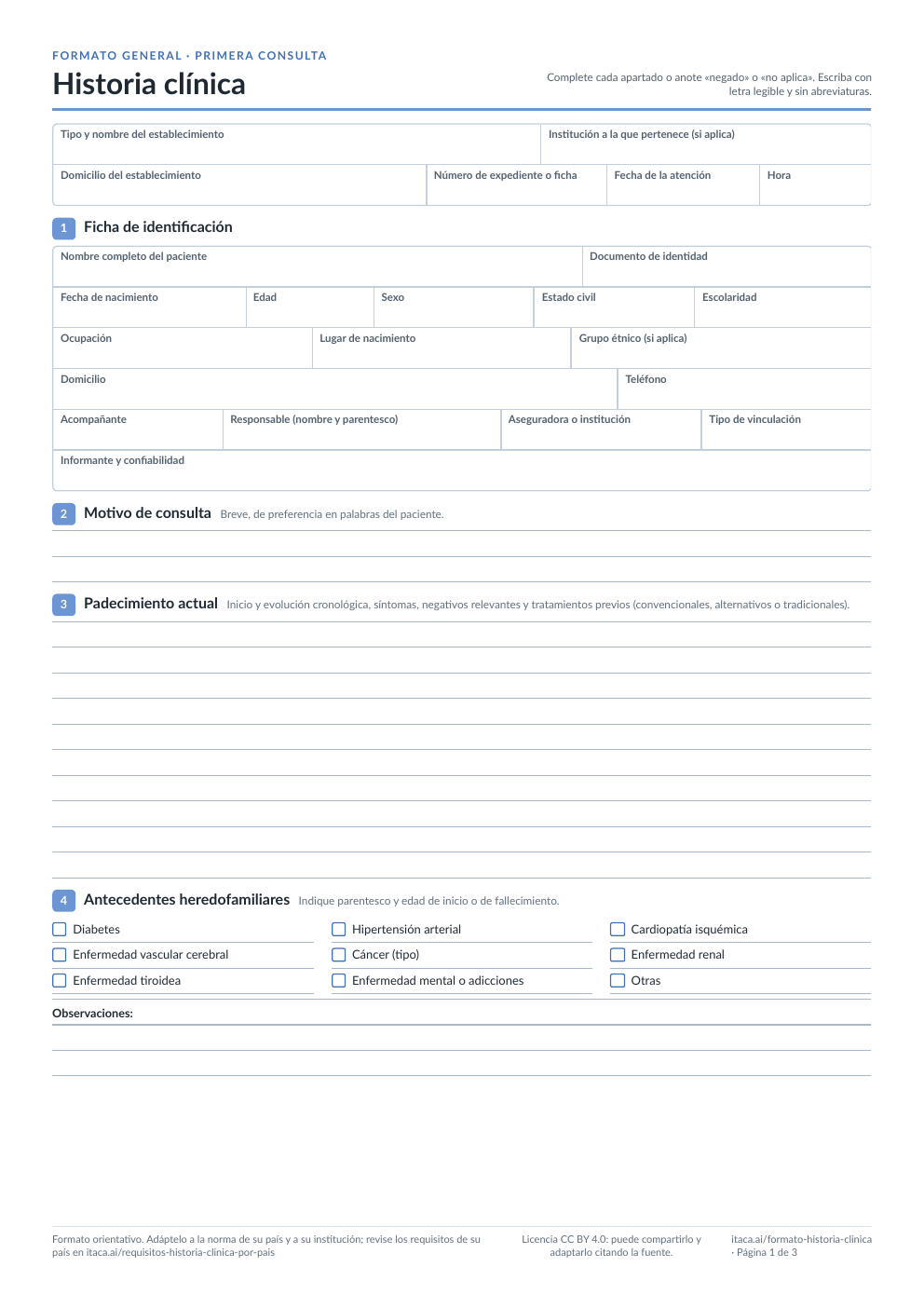
This format of the medical record gathers, in the usual order, the sections of a first consultation: identification, questioning, physical examination, studies, diagnoses, prognosis, plan, and signature. You can download it for free in PDF format for printing or in Word format to adapt it to your consultation, and review an example filled with a fictitious patient.
Last revision: November 22, 2026
Download the medical record format
- Three A4 pages with the 14 sections and lines for writing.
- Editable Word version: add, remove or rename fields according to your specialty.
- No registration or mail required: the download is direct.
License CC BY 4.0You can share it and adapt it by citing the source (Itaca, itaca.ai/format-clinical-history/).
It is an indicative format. Adapt it to the standard of your country and your institution: review the Clinical history requirements by country.
How fragmented a medical record format is
A complete medical history follows the order of the consultation: what the patient tells you, what you observe, and what you decide. The format includes these 14 sections:
- Identity card and establishment details. Full name, document, date of birth, age, sex, occupation, address, companion, responsible person and insurer; in addition, the establishment, the file number or record, and the date and time of the care.
- Reason for inquiry. Brief, with the patient's words.
- Current condition. Introduction, chronological progression, associated symptoms, relevant negative findings and previous treatments, including alternative or traditional ones.
- Family hereditary background. Diabetes, hypertension, heart disease, cancer, and other diseases in the family, with relatives and age.
- Pathological personal history. Chronic illnesses, surgeries, hospitalizations, trauma, transfusions, allergies, and current medications, plus tobacco, alcohol, and other substance consumption.
- Non-pathological personal history. Housing, food, physical activity, sleep, immunizations, occupation and exposure.
- Gynaecological and obstetrical background. When applied: menarche, rhythm, date of last menstruation, pregnancies, births, cesareans, abortions, family planning, and screening tests.
- Interrogation of devices and systems. One line per system, with the findings and the negatives that matter.
- Physical exploration. External habitus, vital signs, weight, height, body mass index, and regional examination: head, neck, thorax, abdomen, limbs, and genitals.
- Results of studies. Laboratory, cabinet and others, past and present, always with a date.
- Diagnoses or clinical problems. Numbered, with optional code (for example, CIE-10) and whether they are presumptive or definitive.
- Forecast. For life and for function, and on what it depends.
- Plan and therapeutic indication. Medication, dose, route of administration, frequency and duration; general measures, studies requested, alarm data and next appointment.
- Name and signature of the professional. Full name, ID card or professional registration, specialty, date, time and signature.
What some national regulations require
- Mexico. NOM-004 (number 6.1) requires, as a minimum, questioning, physical examination, study results, diagnoses or clinical problems, prognosis and therapeutic indication, in that order. See Guide to NOM-004 and the clinical record.
- Colombia. Resolution 1995 of 1999 lists the user identification data (Article 9) and requires that each entry be dated, time-stamped, and include the full name and signature, without acronyms (Article 5). See clinical history guide in Colombia.
- Chile. There is talk of a clinical record (Law 20.584). Its regulations, Decree 41 of 2012, set the minimum requirements: patient identification, record number, provider, and chronological record of care. See clinical information guide in Chile.
For Peru, Argentina, Spain and Uruguay, please check the Requirements of your country. Your institution may request additional fields.
Example of a complete medical history
Fictitious case for educational purposes. The patient, the establishment, and the professional are fictional characters and do not correspond to any real person. This is the case with Full example in PDF: an adult who undergoes control of arterial hypertension.
Identity card. Example fictitious patient, male, 52 years old, married, accountant, bachelor's degree. He comes alone; without an insurance company. Informant: the patient himself, reliable. Attention from 22/11/2026 at 10:30.
Reason for inquiry. «I came to check my blood pressure; in the last few months it has been high at home.»
Current condition. Diagnosis of hypertension 3 years ago during a work examination (150/95 mmHg). Initiated Inhertin 50 mg every 24 hours, with good control during the first year. For the last 4 months, he records at home readings of 140 to 150/90 to 95 mmHg in the morning; he admits forgetting 2 to 3 doses per week. He reports mild and occasional occipital headache upon waking, which subsides without medication. He denies chest pain, shortness of breath, palpitations, edema, visual disturbances, and neurological symptoms. He denies alternative or traditional treatments.
Family hereditary background. Father with high blood pressure; died at 71 from a heart attack (the first at 68). Mother, 76, has had diabetes since the age of 60. Two apparently healthy siblings. He denies cancer in the family.
Pathological personal history. Arterial hypertension since 2023. Appendectomy at 19 years old, without complications. Allergy denied. Current medication: losartan 50 mg orally every 24 hours. Smoker of 10 cigarettes per day for 15 years, discontinued 8 years ago (7.5 packs per year). Alcohol: 2 to 3 beers on weekends. Other substances, denied.
Non-pathological personal history. High consumption of salt and processed foods; sedentary lifestyle. Flu vaccination in 2025; does not remember their last tetanus booster. Gynecologists: do not apply.
Interrogation of devices and systems. Cardiovascular: eliminates palpitations, dyspnea on exertion, orthopnea and edema. Renal and urinary: occasional nocturia. Nervous: referred headache. Rest: no abnormalities.
Physical exploration. Blood pressure 148/94 and 144/92 mmHg (right arm, sitting), heart rate 76 per minute, respiratory rate 16 per minute, temperature 36.6 °C, oxygen saturation 97%. Weight 86 kg, height 1.74 m, body mass index 28.4 kg/m², waist 98 cm. Conscious and oriented. Eye fundus without visible abnormalities; no carotid splints; rhythmic cardiac sounds, no sploshes; lungs well ventilated; abdomen without visceralomegalias; symmetrical pulses, no edema; no focal neurological deficit.
Results of studies. Laboratory results from September 15, 2026: fasting glucose 98 mg/dL, creatinine 0.9 mg/dL, potassium 4.3 mmol/L, total cholesterol 212 mg/dL, LDL 136 mg/dL, HDL 44 mg/dL, triglycerides 160 mg/dL; urine without proteinuria. Electrocardiogram on the day: sinus rhythm, no data of left ventricular hypertrophy.
Diagnostics. 1. Essential systemic arterial hypertension, not controlled with current treatment (CIE-10 I10). 2. Obesity (CIE-10 E66.3). 3. Dyslipidemia (CIE-10 E78.5).
Forecast. Good for life and function; in the long term it depends on the control of the tension and adherence to the treatment.
Plan and therapeutic indication. Losartan 100 mg orally every 24 hours in the morning, continuously (replacing the 50 mg dose). Less than 5 g of salt per day, aerobic activity 150 minutes per week and less alcohol. Measure your blood pressure at home in the morning and at night during the 7 days before the appointment. Serum creatinine and potassium in 2 weeks due to dose adjustment. Tetanus and diphtheria booster. Explanations of alarm data. Appointment in 4 weeks to review the record and estimate cardiovascular risk.
Signature. Dr. Fictitious Name, General Medicine, fictitious professional card. 22/11/2026, 10:55.
How to fill out the form step by step
- Write down the current illness in chronological order. From the onset of the symptoms to the day of the consultation, so that whoever reads it afterwards can understand the evolution.
- Record the negatives that are important. «Denies chest pain» says as much as a positive finding. In the sections that do not apply, write «denies» or «does not apply» instead of leaving them blank.
- Avoid abbreviations. NOM-004 in Mexico (number 5.11) and Resolution 1995 in Colombia (art. 5) require notes without abbreviations or acronyms. Write «blood pressure» and «oral route» in their entirety.
- Complete each medication instruction. Name, dose, route of administration, frequency and duration.
- Close the studies. An undated result does not allow us to know whether it remains in effect.
- Firm with name, date and time. Include your ID card or professional registration.
- Update instead of copying. When the patient returns, record the new information in an evolution note and do not copy the previous history. See What to check before copying and pasting into the medical record.
Formats of medical history by specialty
Each specialty adds its own sections to the general format. We are preparing a format for each; in the meantime, each card leads to the nearest page.
Psychological
History of the problem, mental examination, diagnostic impression and therapeutic plan. Meanwhile: psychotherapy note template.
Nutritional
Anthropometry, 24-hour reminder, frequency of consumption, biochemicals, and nutritional diagnosis. Meanwhile: Nutrition note template.
Pediatrics
Prenatal history, development, immunizations and growth. Meanwhile: Pediatric note template.
Physical therapy
Functional assessment, pain, goniometry, strength, goals and plan. Meanwhile: Documentation in physiotherapy.
Dentistry
Odontogram, treated pieces, procedures and consent. Meanwhile: Guide to Dental Medical Records.
Gynecological
Extended gynaecological and obstetrical history, gynecological examination and screening tests. Meanwhile: Gynaecology and Obstetrics Note Template.
Medical history, clinical record and clinical file
The names change depending on the country. In Mexico, the clinical record is the set of documents of the patient and the medical history is one of them, along with the notes of evolution, interconsultation and referral (NOM-004, numbers 4.4 and 6.1). In Chile, a clinical record is used for the complete registration. In Colombia, Peru, Argentina, Spain and Uruguay, clinical history is spoken of, both in paper and electronic format. The minimum content and the retention time also vary: see the Clinical history requirements by country.
From a paper format to a medical history that is filled out on its own
Filling in 14 fields manually takes time that you could dedicate to the patient. If you already work with this format or a custom one, you can send it to Itaca and convert it into a reusable template. During the consultation, Itaca prepares the draft with the same structure and you review it, correct it, and sign it. The clinical decision and responsibility remain yours.
See how they work clinical note templates or know about it clinical notes with AI from Itaca.
Frequently Asked Questions
What should a medical history contain?
Identification of the patient and the establishment, reason for consultation, current condition, history, questioning using devices and systems, physical examination, study results, diagnosis, prognosis, treatment plan and indication, and the name and signature of the professional with date and time. The minimum legal requirement depends on each country.
Does this format comply with NOM-004 or Resolution 1995?
It includes the sections listed in NOM-004 for the medical history (number 6.1) and the identification data of Article 9 of Resolution 1995, but is a guideline format and by itself does not guarantee compliance with any standard. Your institution may require additional fields. Review your country's guide Clinical history requirements by country.
Can I modify the format?
Yes. The Word version is editable: you can add, remove, or rename fields to adapt it to your specialty or your institution. It has a license CC BY 4.0You can share and adapt it, also in your institution, citing the source.
What is the difference between a medical history and a progress note?
The medical history is drawn up during the initial care and gathers the complete context of the patient. The progress note records each subsequent consultation: changes in the patient's condition, vital signs, new findings, diagnoses, and treatment. See SOAP note template.
Is clinical history the same thing as a clinical record?
Not exactly. In Mexico, the clinical record is the set of documents of the patient and the medical history is one of them (NOM-004, numbers 4.4 and 6.1). In Chile, they speak of a clinical record.
Can I bring the medical history in electronic format?
Yes, within the terms set by the regulations of each country. See What is electronic health record and its components.
Sources
- NOM-004-SSA3-2012, On the clinical record (Official Journal of the Federation)
- Resolution 1995 of 1999, management of the medical history (Ministry of Health of Colombia)
- Law 20.584, rights and duties in health care (National Library of Chile)
- Decree 41 of 2012, Regulations on Clinical Records (National Library of Chile)