



An emergency medical note must allow another professional to understand, without reconstructing the care from memory, why the patient consulted, what was found, what decisions were made, what interventions were performed, and what the final disposition was. The length may vary; what is essential is that the record preserves the clinical sequence and distinguishes observed data from professional assessment.
This guide offers a practical structure, an example, and a review checklist. Adapt the fields, signatures, timelines, and retention rules to your department's protocol.

Structure of an emergency medical note
The note must follow the actual course of care. Not all cases require the same level of detail, but a stable structure makes it easier to record what is relevant even when the treating professional changes or the patient moves to observation, hospitalization, referral, or discharge.
| Section | What is worth documenting | Control question |
|---|---|---|
| Identification and time | Patient, date, time, and context of care. | Is it clear who the note belongs to and when it happened? |
| Reason for consultation | Main problem expressed concretely and its initial priority. | Is it clear why he went to the emergency room? |
| Present illness | Onset, evolution, characteristics, associated symptoms, and relevant negative data. | Can the chronology be followed without inferences? |
| Relevant background | Comorbidities, allergies, medications, procedures, and history related to the episode. | Did I include what modifies the evaluation or the plan? |
| Initial assessment | Vital signs, general condition, triage, and alarm findings when applicable. | Is the arrival state described? |
| Physical examination | Relevant findings, organized by systems or by clinical problem. | Did I separate the observed findings from my interpretation? |
| Studies and interventions | Reviewed tests, treatments, procedures, and observed response. | Can it be reconstructed what was done and what changed? |
| Evaluation | Clinical impression, active problems, considered diagnoses, and rationale for relevant decisions. | Is the assessment supported by the recorded data? |
| Plan and layout | Observation, discharge, admission, referral, or transfer; instructions, follow-up, and warning signs communicated. | Is it clear what happens next? |
| Authorship and review | Person in charge, date, time, signature, and corrections according to the system and local rules. | Does the final version identify who reviewed it? |
Practical example of an emergency room note
The following example is deliberately brief and fictitious. It illustrates the organization of the document, not a diagnostic or therapeutic protocol.
Reason for consultation
Recent onset abdominal pain.
Relevant history and background
Adult female patient with localized pain, evolution of several hours, and associated nausea. She denies trauma. Medical history, regular medication, and confirmed allergies are recorded during the interview.
Evaluation
Vital signs, general condition, and targeted abdominal examination are documented. Available results and the response to interventions performed during observation are incorporated.
Assessment, plan, and disposition
The clinical impression is recorded with its rationale, the alternatives considered, and the disposition decision. The final note records instructions, follow-up, explained warning signs, and the person responsible for the review.
A useful note does not need to turn every encounter into an extensive narrative. It should preserve the data that explains the decision and avoid generic phrases that could apply to any patient.
Documenting the evolution without waiting for the end
In the emergency department, the patient's condition, available information, and the plan can change during the course of a single visit. A single retrospective note can obscure that sequence. When institutional workflow requires it, record re-evaluations with date and time, the data that prompted a change, and the subsequent response.
- New result: identify what information appeared and how it was interpreted.
- Clinical change: describe the observable finding and the corresponding reassessment.
- Change of plan: make the reason, the action taken, and the current provision explicit.
- Communication: Record instructions, interconsultations, shift handovers, or information provided to the patient when relevant.
Initial note, evolution, delivery, and discharge: they do not fulfill the same function
| Document | Main function | Content that sets it apart |
|---|---|---|
| Initial note | Explain the arrival status and the evaluation approach. | Reason, chronology, relevant history, examination, initial assessment, and plan. |
| Evolution note | Show changes during care. | Reevaluation, new results, response, and plan adjustments. |
| Delivery or transfer | Ensure continuity among professionals or services. | Active problems, pending items, interventions, risks, and next action. |
| Discharge summary | Close the episode and communicate the subsequent plan. | Condition upon discharge, instructions, medications, follow-up, and warning signs. |
To delve further into the conclusion of the episode, please refer to guide on the emergency room discharge summary. For a specific case of chest pain, review the documentation structure for suspected ACS.
Checklist before signing
- The identification, date, and time correspond to the correct episode.
- The reason for consultation and the chronology are understood without mentally filling in the gaps.
- Relevant medical history, allergies, and medications were confirmed or marked as unavailable.
- The examination and results are separate from the clinical assessment.
- Interventions and re-evaluations appear in an understandable sequence.
- The final disposal matches the documented plan.
- Instructions, follow-up, and warning signs were recorded when applicable.
- Errors regarding identity, laterality, dosage, units, dates, and negations were corrected.
- The note identifies the reviewer and complies with the applicable institutional and local format.
Frequent errors in emergency department notes
The hardest problems to detect are not always notes that are too short. They also appear when the text is long but does not explain the decision. Pay special attention to these patterns:
- Copy without updating: keep data from another visit or an assessment that has already changed.
- Record unsupported conclusions: writing an impression without the findings that contextualize it.
- Skip the re-evaluation: documenting an intervention without recording the observed response.
- Use ambiguous text: resorting to “stable,” “unchanged,” or “is explained” without specifying what was evaluated or communicated.
- Confusing draft and final record: Sign generated or dictated content without reviewing names, negations, values, and plan.
How Itaca can help with emergency department documentation
From attention to a structured draft to review
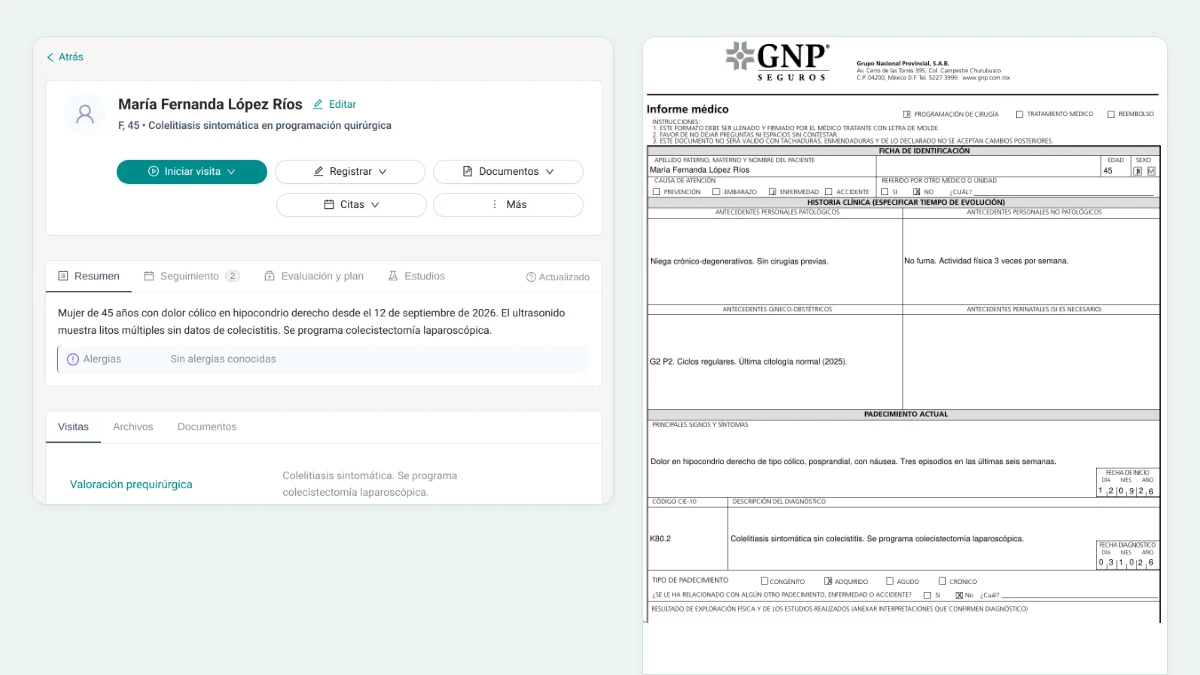
Itaca can organize the conversation and available context into a draft note while you attend. When finished, you review the background, findings, assessment, plan, and disposition; correct any errors; and approve the appropriate version.
Customizable templates allow you to adapt the order to your service workflow and maintain a consistent structure. See how this workflow integrates into the AI for emergency physicians.
Frequently Asked Questions
What should an emergency medical note include?
You must describe the reason for consultation, chronology, relevant history, initial evaluation, examination, studies and interventions, assessment, plan, and disposition. The exact format depends on the department and local requirements.
Does an emergency note have to use the SOAP format?
Not necessarily. SOAP can be useful, but many services use problem-oriented formats, institutional templates, or a combination of initial notes and progress notes. What matters is that the structure clearly represents the episode and complies with applicable rules.
What is the difference between a progress note and a discharge note?
Evolution records changes, results, and adjustments while care continues. The discharge note closes the episode and documents the discharge status, instructions, follow-up, and information communicated to the patient.
How to document quickly without omitting important information?
Use a stable structure, document re-evaluations as they occur, and end with a brief checklist. A template should remind you of relevant fields, but never substitute for the review of the specific case.
Can I directly sign a note prepared by AI?
Before approving the note, confirm identity, denials, history, findings, results, medications, doses, units, assessment, plan, and disposition.
Sources and related resources
- American College of Emergency Physicians: Resources on Emergency Department Electronic Health Records.
- World Health Organization: Clinician Documentation Hub.
- World Health Organization: checklists for emergency care and transfers.
- How to document the chief complaint and severity during triage.
- Frequent errors in clinical documentation and how to prevent them.


Leave a Reply