


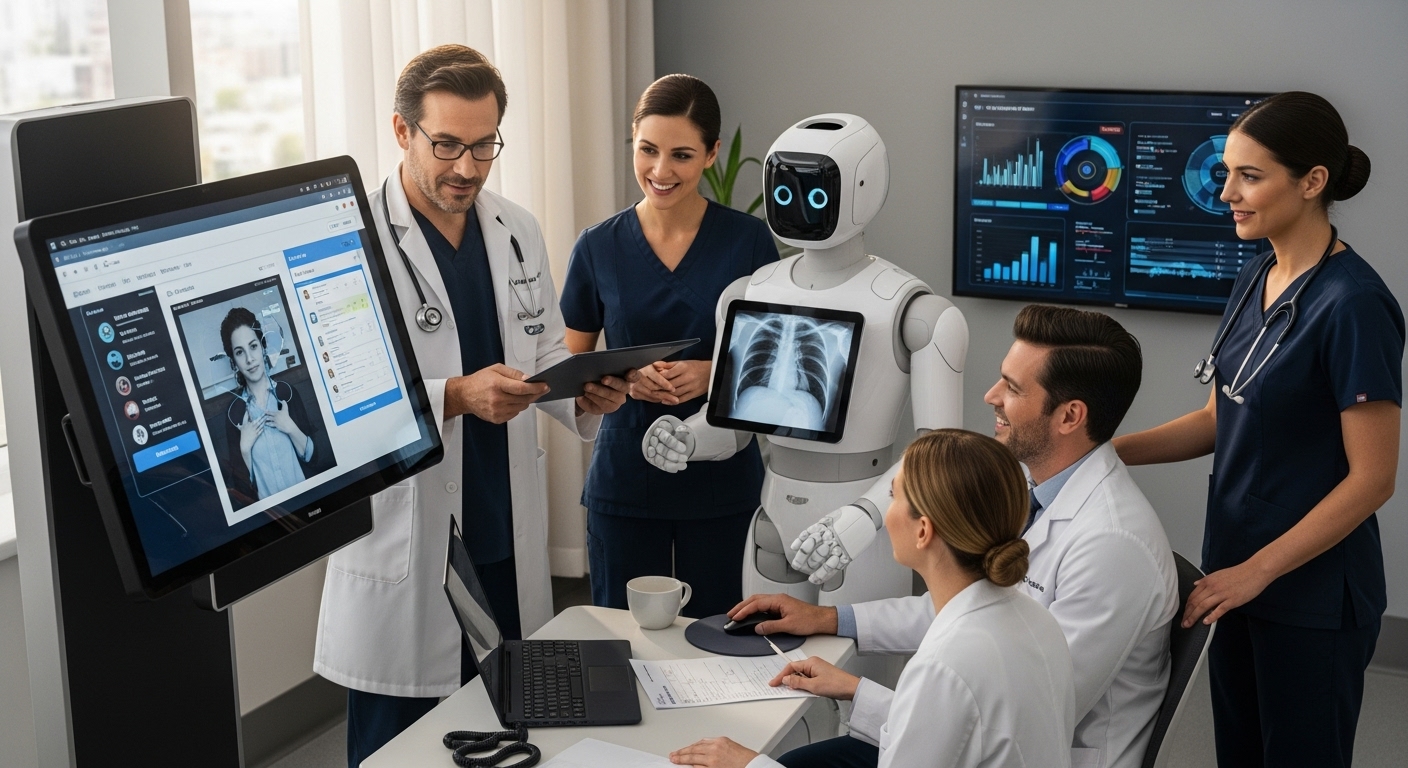
Artificial intelligence in medicine is applied to specific tasks: document consultations, find evidence, support clinical interpretation, analyze images and signals, monitor changes over time, coordinate operations, and accelerate research. Its value does not depend on whether a tool “uses AI,” but on whether it solves a well-defined task, has been evaluated for that use, and maintains human review proportional to the risk.
This guide organizes the main applications of artificial intelligence in medicine according to the work they perform, the data they require, the output they produce, and what a professional must verify before using them. The examples are illustrative: availability, regulation, and the required level of supervision vary depending on the tool, the institution, and the country.
What are the applications of artificial intelligence in medicine?
In practice, the most relevant applications can be grouped into seven areas. Some revolve around care—for example, preparing documentation—others help examine clinical information, and others are part of medical products with a specific medical purpose. Not all carry the same level of risk or should be evaluated with the same criteria.
| Application | Regular entry | Result | What needs to be verified |
|---|---|---|---|
| Clinical documentation | Conversation, notes, audio, or documents | Draft note or document | Accuracy, omissions, and professional approval |
| Clinical Questions and Evidence | Medical question and relevant context | Synthesis with references | Sources, date, population, and applicability |
| Decision support | Structured clinical data or text | Alerts, classifications, or possibilities | Validation, biases, false positives, and context |
| Images and Signs | Radiology, pathology, ECG, or other signals | Detection, measurement, segmentation, or prioritization | Authorized indication and performance in the population |
| Monitoring and tracking | Symptoms, devices, laboratories, and evolution | Trends or alerts | Data quality, thresholds, and response protocol |
| Health operations | Agenda, capacity, coding, and flows | Prediction, classification, or automation | Process errors, fairness, and possibility of correction |
| Research | Literature and datasets | Hypothesis, synthesis, or candidate selection | Method, traceability, reproducibility and limits |
1. Clinical documentation and administrative work
Generative AI can turn a conversation, dictation, or already available information into a structured draft. During a consultation, this can mean preparing a note SOAP, a summary, a referral, or a related document while the physician focuses on care.
Itaca prepares the draft and keeps data requiring attention visible. Before approval, review clinical facts, negations, dosages, temporality, patient identity, and any unclear information.
In Itaca, this use takes the form of clinical notes ready for review. The application helps organize what should remain in the file and reduces the work surrounding documentation.
2. Clinical responses, evidence search, and synthesis
An AI system can locate information, gather sources, and produce a shorter response than a manual search. It is useful for addressing a specific question, reviewing a recommendation, or identifying documents that deserve a complete reading. For broad questions, a deep research mode can organize multiple sources and show how the synthesis was constructed.
The presence of citations improves traceability, but does not in itself guarantee that the answer is correct. It is advisable to open the source, verify that it supports the claim, check the date, and assess whether the studied population corresponds to the patient or clinical context. It is also important to distinguish between a guideline, a review, a trial, and an opinion.
See how they work clinical answers with sources and when it's best to switch from a quick response to deep research.
3. Decision support and clinical reasoning
support systems can sort a list of possibilities, point out interactions, calculate risks, detect discordant data, or remind of steps that are usually omitted. In a complex case, the artificial intelligence applied to clinical diagnosis It can also help structure the problem and make pending questions visible.
“Supporting” does not mean deciding. The usefulness depends on the quality of the data, the environment in which the system was validated, and how often it generates irrelevant alerts or misses important events. A result may seem convincing yet still be based on incomplete information.
Therefore, the professional must be able to know what information the tool used, correct the context, and discard the suggestion. In Itaca, the clinical case analysis It is presented as a support to organize reasoning; diagnosis, treatment, and the final decision remain in the hands of the physician.
4. Medical Image and Signal Analysis
In radiology, pathology, dermatology, ophthalmology, and cardiology, models can detect findings, delineate structures, quantify changes, or prioritize studies for review. Here, it is usually a specific medical purpose, not a general text assistant.
The FDA list of AI-enabled medical devices It illustrates the variety of products authorized in the United States and makes it clear that authorization corresponds to a defined use. The fact that an algorithm works for one modality, population, or task does not allow its performance to be extrapolated to any other.
Before incorporating it, an organization must review the indication for use, validation data, integration with the specialist, management of uncertain results, and the post-implementation monitoring plan.
5. Monitoring, prediction, and longitudinal tracking
Models can analyze changes in symptoms, labs, home measurements, devices, or previous records to recognize trends and generate alerts. In chronic diseases, these systems can help prioritize reviews or identify who should be contacted sooner.
The difficulty does not end with producing an alert. It is necessary to define who receives it, within what time frame they must act, what happens outside of business hours, and how the response is documented. Missing measurements, misused devices, and differences between the development population and the actual population must also be considered.
6. Clinic and hospital operations
Artificial intelligence is also used outside of clinical decision-making: document classification, scheduling, no-show prediction, capacity allocation, coding, task prioritization, and incomplete record review. These applications can reduce friction, but they can also affect access and workload.
In a clinic, the criterion for success should not be how many AI features were purchased, but what changed in the operation: less pending documentation, greater consistency, more accessible information, and real adoption by professionals. The implementation must allow for error correction and prevent opaque automation from becoming a barrier for patients or teams.
Learn how Itaca approaches the documentation and coordination work for clinics and medical teams.
7. Medical research and treatment development
In research, AI can support literature searches, data extraction, cohort identification, image analysis, hypothesis generation, and candidate prioritization. These tasks can accelerate workflow stages, but they do not eliminate the need for a protocol, bias control, external validation, and scientific review.
A recent review on AI in medicine describes applications throughout the clinical record, examination, imaging, treatment, prognosis, and research. The common point is that technical performance must be interpreted within the clinical and ethical context, not as a universal property of the model. See the PubMed review.
Not all “medical AI” is the same type of tool
- Generative AI: generate text, summaries, or drafts from instructions and context. It can invent data or references if proper controls are not incorporated.
- Decision support: transforms clinical data into an alert, classification, or recommendation for a defined task. Its evaluation must consider sensitivity, specificity, calibration, and the consequences of error.
- AI-powered medical device: It has a specific medical purpose and may be subject to regulatory authorization or surveillance depending on the jurisdiction.
- Operational automation: organizes administrative or workflow tasks. Although it does not diagnose, it can have an impact on access, timelines, and equity.
The category determines what evidence is needed and who must supervise the result. Asking a general chatbot to interpret an image does not make it a validated device; using a regulated model for a different indication does not automatically preserve its performance. See also this guide on types of clinical support tools.
How to evaluate an AI tool before using it
- Define the task. Does it document, search for evidence, classify, predict, or propose an action?
- Identify the user and the time. Is it used by a doctor, an administrator, or a patient? Before, during, or after care?
- Review the evidence. Check for which population, institution, and outcome it was evaluated. A retrospective study does not equal demonstrated clinical impact.
- Examine the data handling. Know what information is collected, where it is processed, who can access it, and what agreements apply to your organization.
- Design the human review. Determine what must be checked, who approves, and how a correction is recorded.
- Measure the actual result. Monitor time, quality, errors, adoption, and unintended consequences after implementation.
The World Health Organization proposes that the design and use of AI for health protect autonomy, well-being, transparency, accountability, inclusion, and sustainability. The American Medical Association use the concept of augmented intelligence to emphasize that technology should reinforce, not displace, human capability.
Where does Itaca fit in
Itaca focuses on the work surrounding clinical practice: preparing documentation for review, answering questions using sources, helping research complex topics, and structuring medical cases. You retain control over the chart and clinical decisions.
Frequently Asked Questions
What are the main applications of artificial intelligence in medicine?
The main applications are clinical documentation, evidence search and synthesis, decision support, image and signal analysis, longitudinal monitoring, healthcare operations, and research. Each uses data, produces results, and requires different controls.
Is every AI tool used in healthcare a medical device?
No. The classification depends on its purpose and the applicable regulation. An administrative tool or a writing assistant is not evaluated in the same way as a system intended to detect an injury or calculate clinical risk.
Can AI diagnose autonomously?
There are authorized products for very specific medical tasks, but that does not turn just any AI system into a reliable autonomous diagnosis. In general clinical practice, the professional must interpret the result, integrate the context, and assume the decision.
How does generative intelligence differ from clinical decision support?
Generative AI produces new content —such as text or summaries— from prompts. A decision support system is designed for a defined clinical task and returns an alert, classification, or estimate. They may share technology, but their purpose and evaluation are not the same.
How do you check the reliability of an AI clinical response?
Review the sources, confirm that they support each claim, check their date and design, and assess whether they apply to the specific population and problem. In addition, cross-check the response with the patient's complete data and local guidelines.
Recommended sources and readings
- WHO: Ethics and governance of artificial intelligence for health.
- WHO: recommendations on the safe and ethical use of large language models for health.
- FDA: Artificial Intelligence-Enabled Medical Devices.
- Artificial Intelligence in Medicine: Basic Knowledge, Applications, Ethics and Perspectives, narrative review.
- AMA: The emerging landscape of augmented intelligence in health care.



Leave a Reply