


It's Thursday night. You finish your consultation, close the notes, and open your email.
Three magazine newsletters that you haven’t read. A link that a colleague sent you with the message «Did you see this?» A warning from a medical society that you saved for later.
Thousands of new articles are published every week. Although only a few of them touch on your specialty, finding them forces you to go through summaries, open tabs, and decide what’s worth reading. And that, after an entire day of patients, almost never happens.
So the eyelashes accumulate, and the feeling arises that something important has been missed.
For that we created the Evidence radar.
What is the Evidence Radar
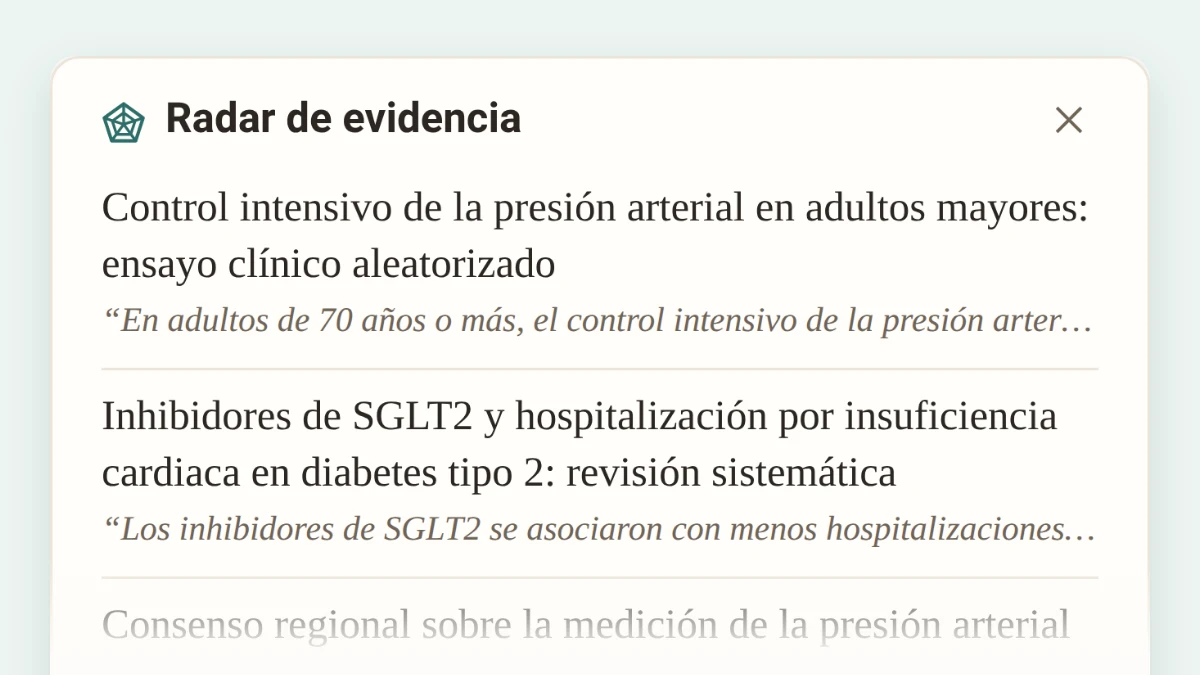
It's a weekly selection of newly published clinical evidence in the topics you follow. Every Friday you have a new edition with what's worth reading that week in your specialty. That's all.
It is not a newsletter or a summary written by third parties. Each publication appears separately. in the words of the person who published itThe original title, the journal, the date, the type of study and the main finding cited in text.
You read it in five minutes. And if something interests you, you delve deeper with a click.
This is how it works
1. Choose up to three interests
A specialty can be your entire field of expertise, such as cardiology, dermatology, or neurology, or a more specific topic within those fields: heart failure, psoriasis, thrombosis, and hemostasis. Your specialty suggests some options, but the choice is yours.
Why only three? Because the idea is to read less and better. With three well-chosen interests, the reading ends.

2. Every week we look for the latest news from top-tier sources
The Radar reviews what was published during the week in:
- International magazinesThe New England Journal of Medicine, The Lancet, JAMA, BMJ, Nature, the journals of the American Heart Association and the major medical publishing houses.
- Health authorities: WHO, the OPS, the FDA and the European Medicines Agency.
- Latin American sources: The SciELO collections from Mexico, Brazil, Chile, Colombia and Argentina, the Mexican Medical Gazette, Mexican Public Health and other journals from the region.
Look for original research, systematic reviews, guidelines and consensus, regulatory updates and public health alerts. Leave out press releases, blogs and republished summaries: only the original source.
3. On Friday, your edition is ready
The edition is published on Friday at 00:01 in your time zone, so you have it ready with your first cup of coffee. If you activate email, you’ll also receive it early on Friday.
On Itaca, the Radar appears on your home page with the three main posts of the week, one from each interest, and stays there until you close it.

What you find in each publication
Each publication of the Radar is designed to answer a single question quickly: Does this change anything for my patients?
- The main finding, above. A textual quote from the publication, so that you can understand the result before deciding whether to continue reading.
- The authors' summary. Background, methods, results and conclusion, as published by the magazine.
- Summarize. If you prefer a synthesis with the findings, the population, limitations, and clinical applicability, Itaca prepares it based on the publication.
- Open the original. The direct link to the publication, always.
- Questions to deepen the discussion. For example, «How were the variables defined?» or «Does this apply to patients with chronic kidney disease?» One click and the question is passed on. Evidence, With the publication as a source. You can also write yours.

Before applying a study, it is worth checking that it answers your clinical question. We explain this in this guide.
We didn't fill out the edition to make it look complete
This is the part that matters most to us.
There are weeks when, on a topic, nothing is published that meets the criteria. When that happens, the Radar tells you: «No new publication met the quality criteria this week». It doesn’t fill it with old articles or press releases.
In addition, each publication undergoes several checks before reaching you: that it comes from an accepted source, that its date falls within the week of publication, and that the cited finding actually appears in the publication. If something doesn’t add up, it isn’t published.
The selection is made with the support of artificial intelligence. That’s why we always show you the original text and the link to the source: the clinical decision remains yours, with the complete evidence at hand.
Who it is for
It's for you if:
- You want to stay up to date in your specialty without spending hours every week.
- You prefer to read the original source before the summary of someone else.
- You are interested in Latin American evidence, not only that from the United States and Europe.
- You want to move from «I read it» to «I applied it,» asking questions about the publication.
It's not for you if You're looking for an endless feed of medical news, or an exhaustive review of everything published about a topic. That's what this is for. Evidence, With his search and Deep Research, Not the Radar.
Your first edition
Choosing your interests takes a minute. The first edition arrives on Friday.
Up to three interests · Every Friday · Optional email
Are you still not using it Itaca? Create your free account.
Frequently Asked Questions
How much does the Evidence Radar cost?
Reading the Radar is free: it comes with Itaca Evidence. Using «Summarize» or asking a question about a publication counts as a query in your plan, just like any other question in Ithaca.
How often is it published?
Once a week, on Fridays. Each edition brings together the material published in the previous days.
In which language are the publications?
Itaca works in Spanish, Portuguese and English. The publications appear in the language in which they were published, because we show you the original text and not a translation.
Can I change my interests?
Yes, whenever you want, from «My interests». The changes are saved instantly.
Will I receive mail?
Only if you activate it. The Friday email is optional and you can turn it off whenever you want.
Can I see previous editions?
Yes. On the Radar page you can choose any previous edition.


Leave a Reply