



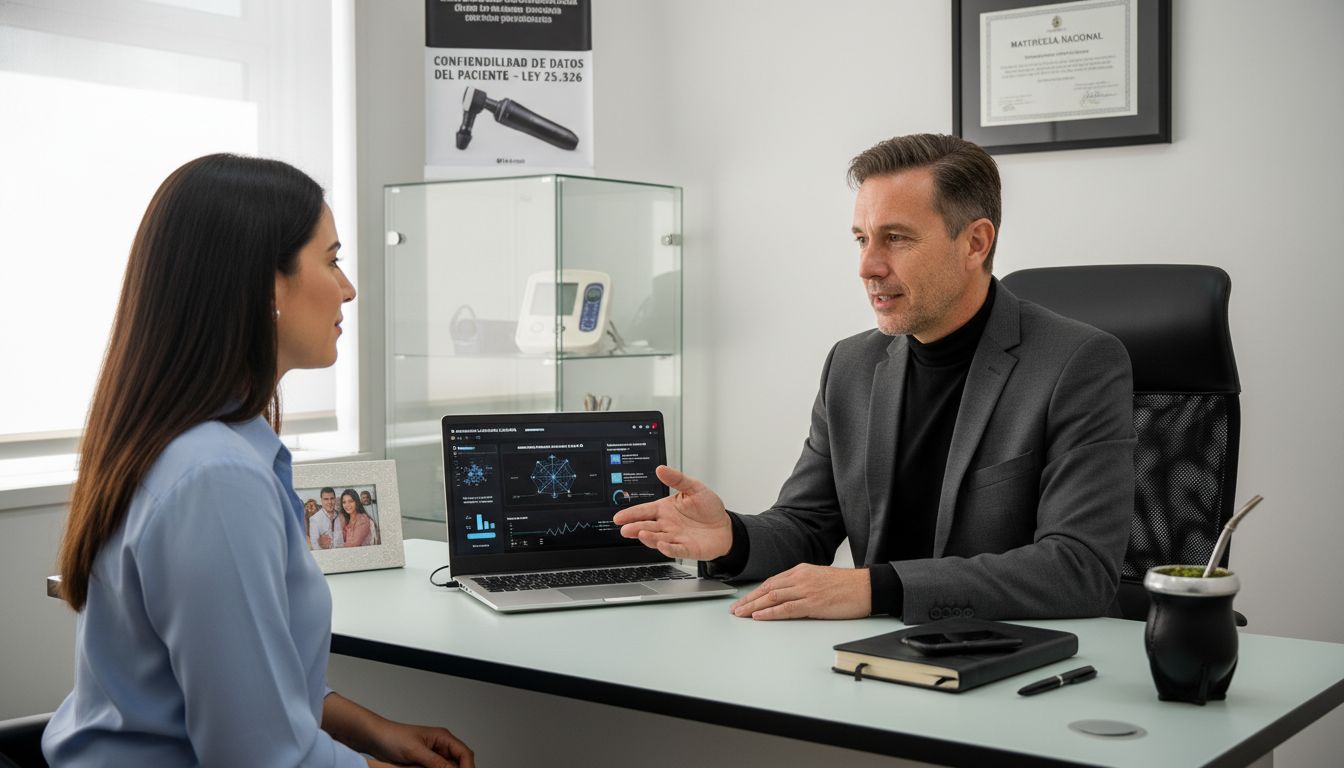
This guide explains how to incorporate artificial intelligence tools into a medical practice in Argentina: identify repetitive tasks, evaluate privacy and professional liability, conduct a limited test, and measure whether the tool improves daily work. For the regulatory and healthcare system landscape, consult the national page linked below.
To review the medical record, data protection, and official sources applicable to the country, consult the Argentine framework for artificial intelligence in medicine.
Table of Contents
- Definition of artificial intelligence in Argentine healthcare
- Clinical Automation: Tools and AI Types
- Benefits for doctors: time and accuracy
- Data Privacy and Local Regulation in Medical AI
- Risks, challenges, and common adoption mistakes
Key Points
| Point | Detail |
|---|---|
| Health Transformation | Artificial intelligence is optimizing diagnoses and administrative management in Argentine healthcare. |
| Benefits for Professionals | Doctors can reduce the time spent on paperwork by up to 70%, thereby improving patient care. |
| Privacy and Regulation | It is crucial to comply with data protection regulations to implement AI responsibly. |
| Challenges in Adoption | Over-reliance on technology and lack of training are common risks in the implementation of medical AI. |
Definition of artificial intelligence in Argentine healthcare
The artificial intelligence (AI) in healthcare represents a technological revolution that radically transforms how medical professionals diagnose, treat, and manage patient information. In the Argentine context, AI is becoming a fundamental tool that optimizes clinical processes, reduces administrative times, and improves diagnostic accuracy.
At its most basic level, medical artificial intelligence consists of computational systems capable of analyzing large volumes of medical data, recognizing complex patterns, and generating recommendations based on scientific evidence. These systems utilize machine learning algorithms that can process medical information much faster than a human professional, identifying correlations and trends that might go unnoticed in a traditional review.
The main components of AI in healthcare include:
- Natural language processing for understanding medical records
- Diagnostic support systems what are the possible diagnoses
- Predictive analytics to identify health risks
- Documentation Automation clinic
For healthcare professionals, Exploring advancements in artificial intelligence in medicine significantly expand their diagnostic and administrative capabilities, allowing them to focus more on direct patient care and less on bureaucratic tasks.
Clinical Automation: AI Tools and Types
The Clinical automation Artificial intelligence represents a radical transformation in medical practice, enabling healthcare professionals to optimize their processes and focus on what truly matters: patient care. AI tools are designed to simplify complex administrative tasks, reduce human errors, and increase efficiency in medical settings.
Several types of automation tools are revolutionizing different aspects of clinical practice. These systems range from medical note generation platforms to advanced diagnostic support algorithms. Upload clinical files and let them integrate into your notes automatically It is a perfect example of how technology can streamline medical processes.
The main types of clinical automation tools are:
Here's a comparison of the main types of clinical automation tools and their key functions:
| Tool Type | Main Function |
|---|---|
| Intelligent documentation systems | Clinical Record Automation |
| Automated SOAP Note Generators | Creating quick and accurate notes |
| Diagnostic support platforms | Diagnostic suggestions |
| Predictive risk analysis tools | Identifying patients at risk |
- Intelligent documentation systems
- Automated SOAP Note Generators
- Diagnostic support platforms
- Predictive risk analysis tools
Each tool is designed to address specific challenges, from reducing administrative burdens to improving diagnostic accuracy, allowing physicians to dedicate more time to direct patient contact.

Benefits for doctors: time and accuracy
The artificial intelligence is redefining medical practice by offering crucial benefits that go beyond simple automation. Healthcare professionals can now dedicate more time to direct patient contact, significantly reducing the administrative tasks that traditionally consumed hours of their workday.
The first fundamental benefit is the Clinical time optimization. AI tools can process medical histories, generate SOAP notes, and perform diagnostic analyses in a fraction of the time a professional would require manually. This not only speeds up internal processes but also allows for more personalized and patient-centered care.
Understanding the differential diagnosis becomes a more efficient and precise process thanks to these intelligent systems.
The main benefits for doctors include:
- Reduction of up to 70% in documentation time
- Greater precision in complex diagnoses
- Reduction of administrative errors
- Better clinical time management
Furthermore, diagnostic accuracy improves significantly. AI algorithms can analyze thousands of medical cases simultaneously, identifying patterns and correlations that might go unnoticed by the human eye, resulting in earlier diagnoses and more personalized treatments.
Data Privacy and Local Regulation in Medical AI
The data privacy In the Argentine medical field, it represents a critical challenge for the implementation of artificial intelligence solutions. Healthcare professionals must navigate a complex regulatory landscape that seeks to protect sensitive patient information while allowing for technological innovation.
Local legal frameworks establish strict requirements for handling digital medical information. The Personal Data Protection Law (Law 25.326) and Ministry of Health regulations provide precise guidelines on how AI tools can manage clinical information. See our FAQs to better understand the specific details of regulatory compliance in medical technologies.
The fundamental principles of data protection include:
- Express consent of the patient
- Anonymization Personal information
- Information security
- Transparency in the use of data
- Access Limits strict
The responsible implementation of medical AI requires a delicate balance between technological innovation and the protection of individual privacy. Systems must ensure that all data is treated with the highest level of confidentiality, utilizing advanced encryption protocols and restricted access that safeguard patient privacy.
Risks, challenges, and common adoption mistakes
The artificial intelligence implementation In medical settings, it is not without significant challenges. Healthcare professionals frequently face technical, cultural, and ethical barriers that can hinder the effective adoption of these innovative technologies.
One of the main risks lies in the technological overdependence. Many doctors make the mistake of considering AI algorithms infallible, forgetting that they are support tools and not replacements for clinical experience. Explore our AI section to better understand how to integrate these technologies without losing professional judgment.
The most common errors in medical AI adoption include:
- Lack of adequate training
- Resistance to technological change
- Underestimation of implementation complexity
- Unrealistic expectations about AI capabilities
- Trouble integrating with existing systems
Successful implementation requires a gradual and strategic approach. Professionals must maintain a critical attitude, continue their professional development, and view AI as a complement that enhances, but does not replace, human clinical judgment. The key lies in progressive adaptation, ongoing training, and always keeping the patient at the center of all medical decisions.
Optimize your medical practice with advanced artificial intelligence
Tired of administrative tasks eating into your valuable clinical time? Intelligent automation is the solution you need to focus on what truly matters: direct patient care. On our platform, you can leverage tools designed for instant SOAP note generation and diagnostic support, which reduce manual documentation by up to 70%. Elevate accuracy and minimize administrative errors without compromising the confidentiality or security of medical data.

Discover how Itaca.ai transform the way you practice medicine by combining innovation and regulatory compliance Access our Collection of guides to better understand each function and stay up to date with the latest technological innovations that can revolutionize your professional routine. It's time to take the step towards a future where technology enhances your clinical experience and your time is truly yours. Visit Itaca.ai and start optimizing your workflow today
FAQ
What is artificial intelligence in healthcare?
Artificial intelligence in healthcare is a computational system that analyzes large volumes of medical data, recognizes patterns, and provides evidence-based recommendations, thereby improving medical diagnoses and treatments.
What are the benefits of AI-powered clinical automation?
Benefits include reduced time in documentation, increased diagnostic accuracy, decreased administrative errors, and better management of clinical time for physicians.
What types of AI tools are used in medical practice?
The tools include intelligent documentation systems, automated SOAP note generators, diagnostic support platforms, and predictive risk analysis tools.
What are the main challenges in adopting artificial intelligence in healthcare?
Challenges include a lack of adequate training, resistance to technological change, and over-reliance on technologies, which can lead to underestimating the complexity of implementation and AI capabilities.



Leave a Reply