



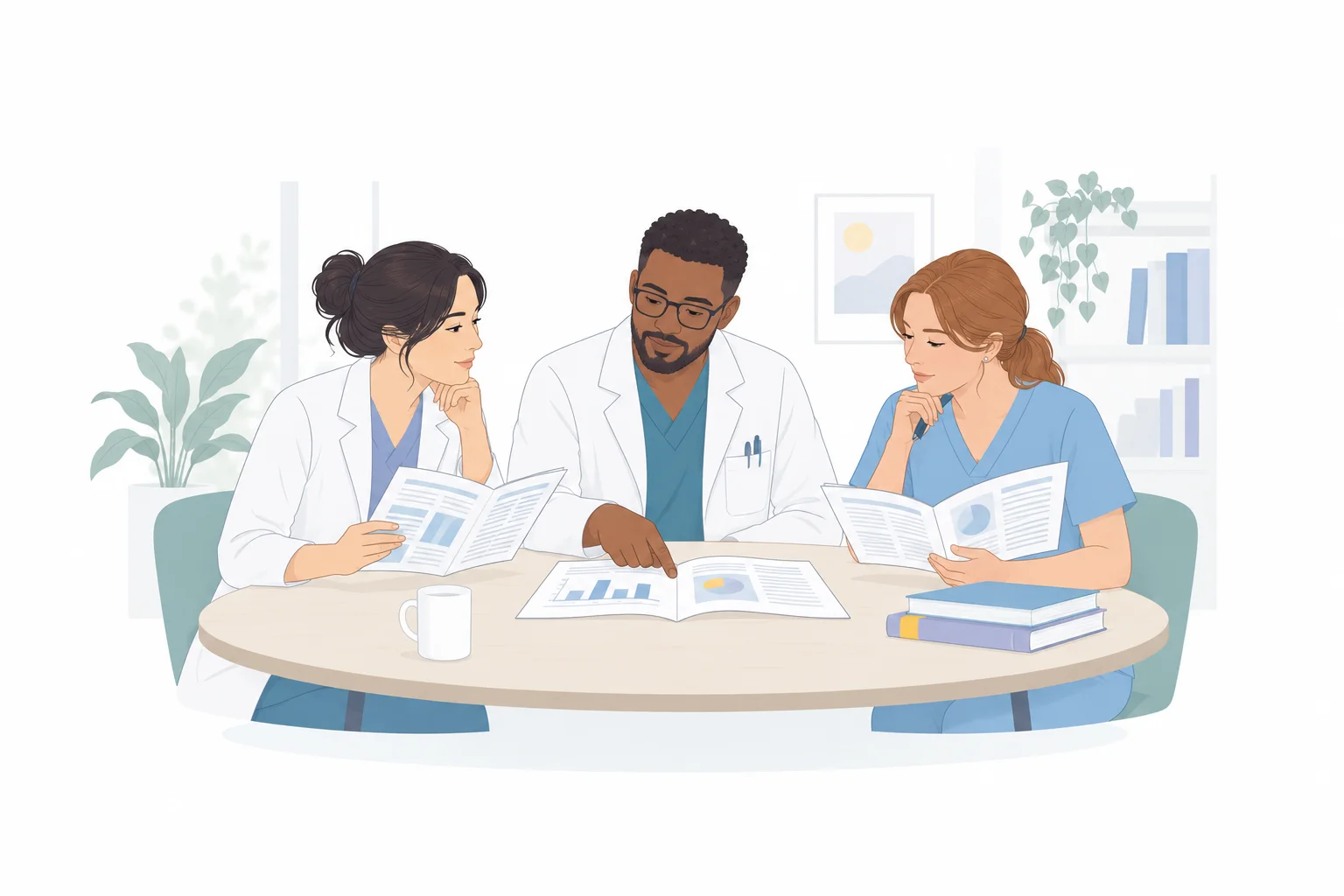
Preparing a literature session doesn’t consist of gathering many summaries. It consists of choosing a question, understanding what each work contributes, and explaining to the team why it deserves their attention. AI can help organize that preparation, as long as the path from the conclusion to the article remains visible.
A useful result is not a finished presentation that no one can verify. It is a manageable selection of readings, accompanied by a summary that allows for discussion of methods, results, and limitations. This flow is intended for a training or update session; it does not replace the method of a systematic review.
Start with a question that fits into one session
“AI in medicine” is too broad. “How is the documentation time being measured with environmental scribes?” allows you to search for jobs, compare their methods, and conclude with a concrete discussion. Also define who the session is intended for: residents, a service, or professionals from different specialties.
Write a sentence with the question and another with the rest of the information. For example, you can review time and usage experience without trying to assess diagnostic accuracy. This delimitation prevents an extensive search from turning into a superficial presentation.
Keep the search, not just the links
Write down where you searched, on what date and with what terms. The PubMed manual It explains how to combine searches, use field labels, and consult the history. Keeping that information makes it easier to repeat the search and understand what might have been missed.
You can ask the AI for synonyms and alternative terms, but try the combinations in the bibliography. A list of references generated in a conversation does not prove that a complete search was performed. Check that each article exists and that its bibliographic data correspond to the linked document.
Select by contribution, not by amount
For a brief session, it is usually more useful to discuss a few works in depth rather than list many. Choose a source that situates the topic and studies that allow the question to be answered. Include results that complicate interpretation, not just those that support the initial idea.
Record why you retain each reading: design, population, comparison, relevant result or limitation. If you do not have the full text, identify that restriction. The summary may help you select, but it does not necessarily contain the details you will need for a methodological critique.
Prepare a sheet per item
Always use the same fields: question; design; context and participants; intervention or presentation; comparison; results; limitations; and usefulness for discussion. Add a page, table, or section when a figure is important. This way you can return to the data without having to search throughout the document during the session.
AI can prepare a first draft based on the available text. Ask it to highlight the fields it does not find instead of filling them in by approximation. Then compare the elements that support its conclusion, especially denominators, follow-up periods, and differences between main and secondary results.
Separate what the work says from its interpretation
In the slides, he distinguishes three levels: the published result, the limitations of the study, and the implications he proposes to discuss. “A reduction was observed” does not equate to “the intervention will work in our service.” The change in context can be precisely the most interesting question of the session.
If you compare recommendations, this guide on clinical responses and evidence It can serve as complementary reading material. Keep the references alongside the corresponding statement, not just in a last slide that is difficult to consult.
End with questions for the team
Reserve the closing for two or three questions: what result would change our way of working? What information is missing? What would be necessary to measure here? You don't need to force a recommendation when the evidence still leaves uncertainty.
For a more comprehensive search, deep research and its Evidence tab They allow you to explore relevant sources, dates, and fragments. Use them as support to get to the readings. The value of the session still lies in a well-chosen question and a discussion that the team can follow and verify.

Leave a Reply