



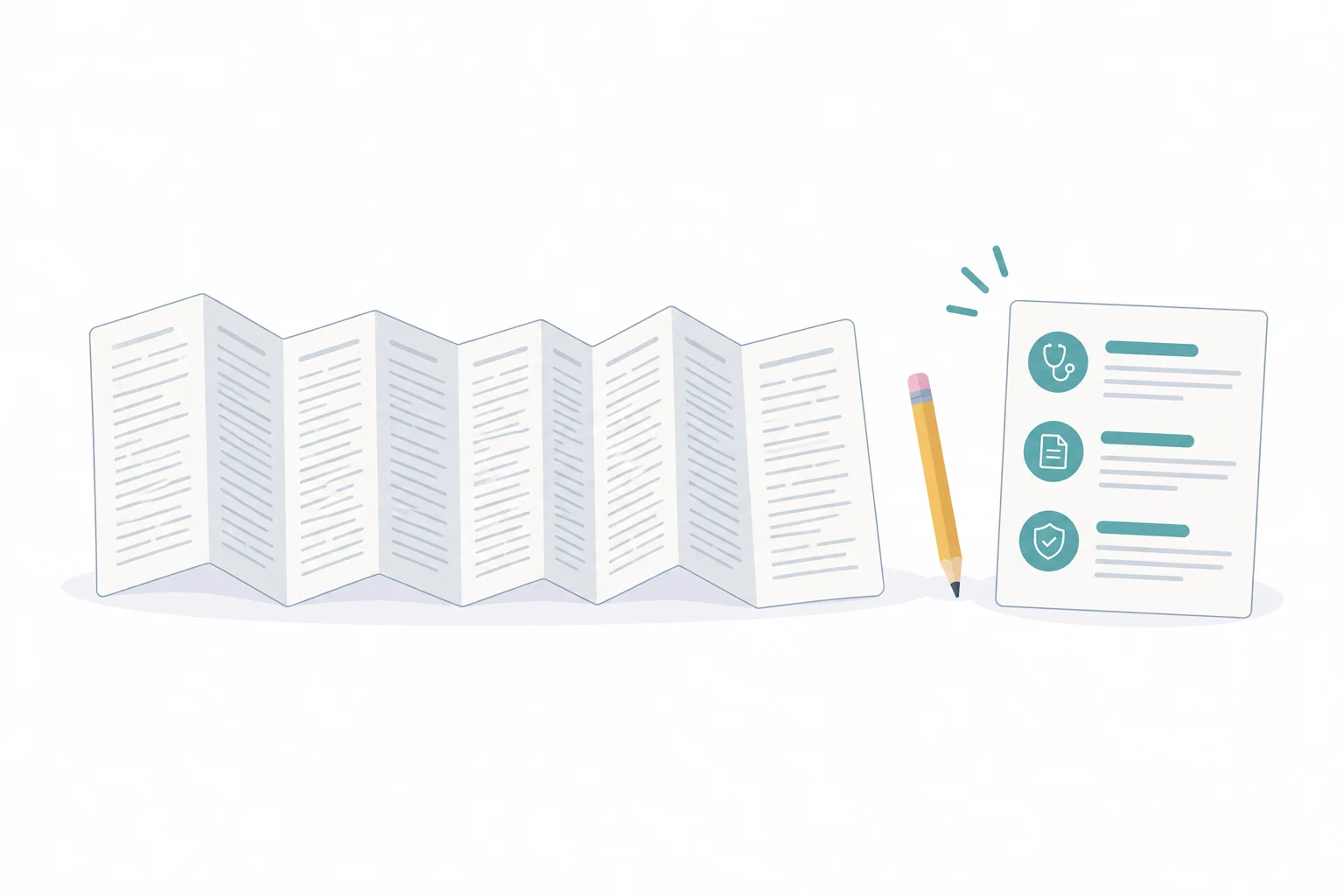
A note can take up several pages and force the next professional to look for what changed. It can also be brief and leave out necessary information. The useful difference is not between writing a lot or a little, but between preserving context and repeating it without a clear purpose.
From the perspective of clinical assistant design, this is an important question: does the document facilitate resuming work or simply produces more text? It is an editorial and product criterion, not an assertion that there is an ideal length for all consultations.
The extension must correspond to the meeting
A first assessment may require more context than a limited follow-up. A meeting with several issues does not require the same level of detail as a timely review. Reducing both to the same number of words would be just as unhelpful as expanding them with an identical template.
Before editing, identify what the reader needs to know to understand the encounter: motive, relevant information, documented assessment, and next steps. The format may vary by specialty. The test is whether it allows finding those elements without reconstructing the query from scattered fragments.
Repeating is not the same as continuing
The previous context matters, but it is important to distinguish it from what happened today. A historical fact may still be relevant without appearing as a current observation. The continuity becomes clearer when the note explains what remains unchanged, what changes, and what remains pending.
The AHRQ review of copy-and-paste in the file Describes the risks associated with transferring text between records. The problem is not in retaining the background information, but in losing its origin or relevance when reusing it. More inherited text does not equate to more new information.
An example of editing without losing the data
Imagine a fictitious note that repeats in three sections: “The study requested previously has already been completed and the document was submitted during this visit.” You can record once the study is available and place your review where appropriate. Repeating the same phrase does not add any interpretation.
On the other hand, it is not advisable to eliminate a relevant clarification just because it increases the length. “The patient reports a dose different from that previously recorded” communicates a difference that deserves to be preserved. Useful editing eliminates redundancy, not uncertainty or necessary context.
The structure only helps if it reflects the content
Headings allow for orientation, but they should not become empty sections or default statements. A research section does not justify adding findings that have not been documented. A template is a help for organizing, not a source of information.
Also observe whether the same content appears distributed in a contradictory manner. An easy-to-read note makes it possible to locate the main data and understand its relationship with the meeting. The appearance of completeness should not depend on filling in all the spaces.
What to ask a document assistant
Define the format and level of detail you need. You can ask that it retain relevant information, distinguish between past and current changes, and avoid repeating the same data across several sections. If there is ambiguity in the entry, it is more useful to make it visible than to convert it into a safe phrase.
Test the result with a representative fictitious meeting. Check what had to be added, removed, or rearranged. This test does not measure only the writing: it shows whether the assistant adapts to the type of work they are doing, rather than imposing a generic grade on them.
A good grade allows you to continue
The reader should be able to understand why the meeting took place, what information was relevant and what was agreed upon. The length necessary to achieve this will depend on the context. That is a more useful goal than always producing the shortest or longest note.
The clinical notes with AI They make sense when they facilitate that work. And when subsequent information arrives, it is advisable to incorporate it within the flow of Studies received after the consultation, Without making the original registration appear to have contained data that was not yet available.



Leave a Reply