



A useful pediatric physical examination does not end upon completing the exploration: the findings must be recorded with sufficient context to guide follow-up. This guide summarizes what to document, how to separate what is observed by the professional from what is reported by the patient or caregiver, and which omissions should be reviewed before closing the note.
Table of Contents
- Concept and purpose of the pediatric physical examination
- Variations by age and developmental stages
- Recommended sequence and exploratory techniques
- Objective and Subjective Recording for Clinical Notes
- Frequent errors and how to avoid them
- Impact on care and decision-making
Pediatric physical examination checklist
The extent of the examination depends on the age, reason for consultation, medical history, and clinical status. As an organizational reference, Bright Futures from the American Academy of Pediatrics It integrates developmental surveillance, physical examination, screenings, immunizations, and anticipatory guidance at age-defined visits. It must be adapted to the guidelines and standards applicable in your country and clinical setting.
- Meeting context: age, reason for visit, source of information, and companion.
- Measurements relevant vital signs and anthropometry, including technique, unit, and date.
- Initial observation: appearance, interaction, breathing, perfusion, mobility, and general status.
- Directed exploration: positive and negative findings relevant to the reason for consultation.
- Growth and development: reference used, trend, and any data requiring confirmation or follow-up.
- Documentary closure: limitations of the examination, evaluation, plan, orders, and next review.
Important: A checklist helps prevent omissions, but it does not turn every encounter into the same exam nor does it replace clinical judgment.
Concept and purpose of the pediatric physical examination
The pediatric physical examination is a fundamental diagnostic tool for assessing a child's overall health status. According to MedlinePlus, during this procedure, the doctor examines the child's body to determine the presence of possible physical problems., employing specific techniques such as inspection, palpation, auscultation, and percussion.
The physical assessment goes beyond a simple superficial review. Represents a systematic process that allows the professional to gather crucial clinical information to detect health problems. Each exploration is designed with the child's specific developmental characteristics in mind, ensuring an accurate assessment tailored to their developmental stage.
The main goals of a pediatric physical examination include:
- Assess the patient's overall health status
- Early detection of clinical conditions
- Monitor child growth and development
- Establish a baseline for future comparisons
- Build a doctor-patient trust relationship
Each element of the examination provides valuable information: from skin color to muscle tone, cardiopulmonary auscultation, and neurological assessment. The integration of this data allows for a comprehensive and personalized diagnosis.
Professional advice: Prepare the child beforehand by explaining each step of the exam in a simple and friendly way to reduce their anxiety and facilitate a more effective examination.
Variations by age and developmental stages
Age modifies both the examination and the way it is interpreted and documented. The WHO child growth standards include indicators such as weight, length or height, body mass index, and head circumference; the specific reference must be chosen according to age and current standards in the place of practice.
Newborns and infants
- Record measurement conditions, diet, hydration, tone, mobility, and response during the examination.
- Record weight, length, and head circumference when applicable, along with the available trend.
- Differentiate the data provided by the caregiver from the directly observed findings.
Preschoolers
- Take advantage of spontaneous observation first: interaction, language, gait, play, and breathing.
- Leave the maneuvers that may cause rejection for the end when the clinical situation permits.
- Document who refers each change and whether the finding could be confirmed during the consultation.
Schoolchildren
- Integrate posture, mobility, growth, and findings related to the chief complaint.
- Record the patient's participation and any relevant discrepancies between their account and that of the caregiver.
- Avoid converting academic or behavioral history into clinical conclusions without sufficient assessment.
Teenagers
- Explain the scope of the examination and document consent, accompaniment, or the use of a chaperone according to local regulations.
- Protect the confidentiality of sensitive information and separate, when applicable, the adolescent's account from that provided by third parties.
- Record only the aspects of pubertal or psychosocial development that are relevant and actually evaluated.
The sequence may vary to preserve cooperation and comfort. The essential thing is that the note makes it possible to know what was evaluated, what could not be evaluated, and what needs follow-up.
Recommended sequence and exploratory techniques
Exploratory techniques in the pediatric physical examination constitute a systematic set of procedures designed to comprehensively assess a child's health status. These techniques include four fundamental methods: inspection, palpation, percussion, and auscultation, each with a specific and complementary purpose for obtaining accurate diagnostic information.

The Pediatric Assessment Triangle offers a rapid initial strategy that prioritizes the observation of three critical elements: appearance, breathing, and circulation. This methodology allows the professional to perform an instantaneous assessment of the patient's clinical status, establishing priorities and guiding subsequent exploration.
The recommended sequence for performing a pediatric physical examination includes the following exploratory techniques:
Inspection:
- General visual assessment
- Posture and Movement Observation
- Skin color analysis
- Facial expression valuation
Palpation:
- Tissue Consistency Exploration
- Detection of masses or irregularities
- Body temperature assessment
- Lymph node assessment
Percussion:
- Organ loudness evaluation
- Detection of full or empty spaces
- Anatomical Limit Analysis
- Assessment of internal structures
Auscultation:
- Heart sounds auscultation
- Lung Sound Assessment
- Bowel sound detection
- Frequency and rhythm analysis
Adapt the sequence to the patient's age, clinical status, and level of cooperation. A trusting environment facilitates a more complete examination.
Each technique requires a specific approach in pediatrics, considering the patient's fragility and sensitivity. Clear communication, gentle contact, and explaining each step beforehand are crucial to ensure the child's cooperation during the examination.
Professional advice: Always start the examination with the least invasive techniques to build trust and reduce anxiety in pediatric patients.
Objective and Subjective Recording for Clinical Notes
In pediatrics, an important part of the history comes from the caregiver and another from the patient themselves. The note must preserve that attribution: a reported symptom is not equivalent to an observed finding, and the absence of a piece of data must not automatically be transformed into a normal result.
| Type of information | How to make things clear with her |
|---|---|
| Referred by caregiver | Identify who provides the data and the chronology they describe. |
| Referred by the patient | Record their exact words or a faithful summary, taking into account their age and communication skills. |
| Observed or measured | Specify method, unit, location, or conditions when they modify the interpretation. |
| Not evaluated or pending | Make it explicit; do not use “normal” to complete a field that was not explored. |
| Clinical interpretation | Separate it from the data and retain the appropriate degree of certainty. |
Example of pediatric examination documentation
Example: School-aged child accompanied by his mother. She reports nocturnal cough of three days' evolution; the patient denies chest pain. He appears alert, cooperative, and without respiratory distress at rest. Respiratory rate recorded for one minute. Auscultation shows bilateral air entry; the rest of the respiratory examination was documented as actually assessed. It was not possible to confirm the name of the medication given at home; verification is pending. Re-evaluation and follow-up criteria are explained.
The example shows attribution, observation, a limitation, and the next step. It must be adapted to the actual encounter and does not work as text to be copied without review. To structure the rest of the consultation, please refer to the initial pediatric note guide by age.
Convert the query into a pediatric draft ready for review
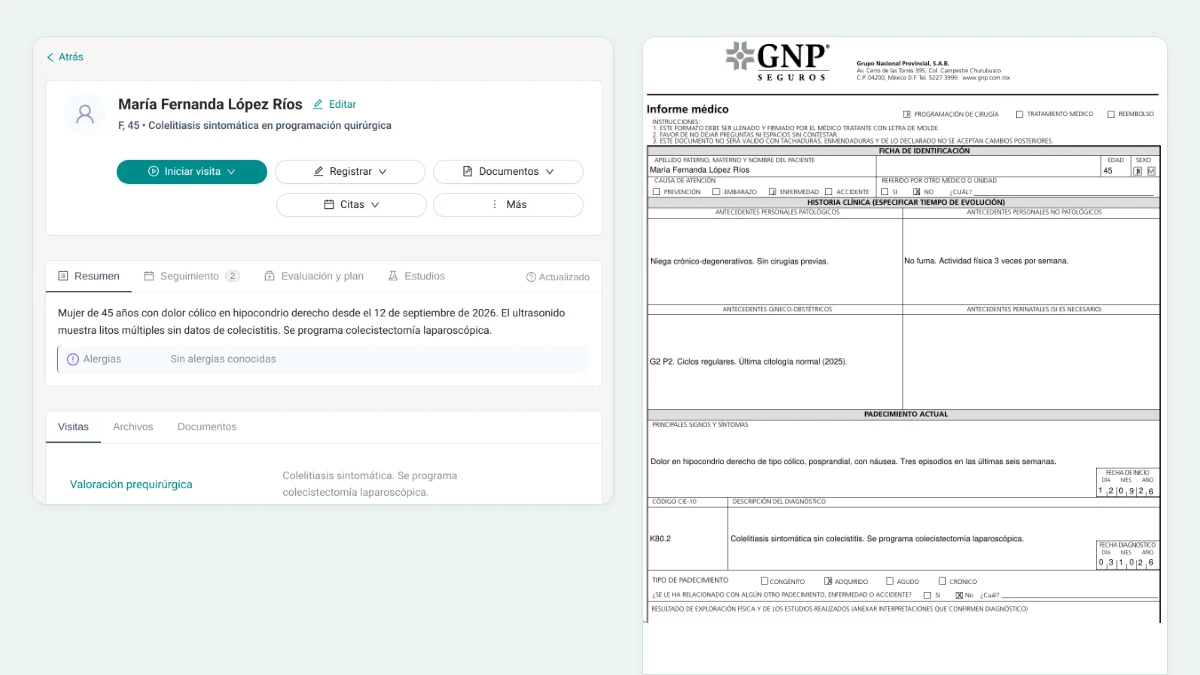
Itaca organizes the reason for consultation, the history, the context provided by the caregiver, and the findings you confirm into a structured draft. You review, correct, and approve it before adding it to the chart.
Frequent errors and how to avoid them
- Record as normal what was not examined. Use “not evaluated”, “was not possible to assess”, or describe the specific limitation.
- Mix the caregiver's account with one's own findings. Attribute each piece of data and separate history, observation, and interpretation.
- Copy a previous exam without confirming changes. Document the current meeting and reuse only verified information.
- Omit units, laterality, or location. Add the necessary context so that another person can interpret the finding.
- Using age-inappropriate references. Identify the curve, range, or instrument used when relevant.
- Leave a finding without a plan. Link the relevant findings with evaluation, monitoring, study, or reassessment criteria.
Before signing, also review identity and encounter, information source, measurements, relevant findings, pending data, and consistency between evaluation and plan. You can use the clinical documentation checklist before signing as a final review.
Impact on care and decision-making
The pediatric physical examination is a critical tool for the early detection and prevention of health problems., allowing medical professionals to comprehensively assess a child's growth and development. This systematic practice not only provides immediate insights but also establishes a crucial baseline for longitudinal monitoring of child health.
The initial assessment in pediatrics directly impacts clinical decision-making, using tools such as the pediatric assessment triangle to quickly classify severity and guide appropriate management. Each physical examination becomes a strategic moment that can define the entire treatment trajectory.
The most significant impacts of the physical examination in pediatric care include:
Early detection of conditions:
- Early identification of developmental disorders
- Recognition of subtle signs of illness
- Timely intervention in emerging pathologies
- Prevention of future complications
Clinical decision-making:
- Definition of personalized therapeutic strategies
- Prioritization of interventions
- Adjustment of existing treatments
- Referral to specialists when necessary
Development Tracking:
- Growth curve monitoring
- Neurological Milestone Assessment
- Psychomotor Development Monitoring
- Identification of potential delays
Psychosocial Impact:
- Building Family Trust
- Clear communication about health status
- Reducing parental anxiety
- Building a Doctor-Patient Relationship
Each physical examination represents more than just a technical procedure; it is a holistic encounter where objective data, subjective perceptions, and the clinician's experience converge. The integration of these elements allows for a multidimensional understanding that goes beyond the simple identification of symptoms.
Healthcare professionals must understand that each physical examination is a unique opportunity to build a comprehensive narrative of a child's health, where each finding can have profound implications for the patient's present and future well-being.
Professional advice: Develop a registration methodology that allows capturing not only objective data, but also the comprehensive context and family perceptions during each exploration.
Document the pediatric visit while you examine
The article emphasizes the importance of a complete and structured pediatric clinical record, integrating objective and subjective data to ensure a comprehensive patient assessment. However, the complexity of collecting and systematizing this information can be a challenge, consuming valuable time and leading to documentation errors, affecting the quality of diagnosis and follow-up. Key concepts such as the SOAP methodology, the balance between objective and subjective records, and the need for a clear and detailed clinical note can be optimized with the right solutions.
Itaca prepares a structured draft from the consultation so you can review, correct, and approve the documentation. This preserves the caregiver's context, clinical data, and confirmed findings without turning patient care into a transcription task.

Meet the Pediatric note template and how does the AI documentation for pediatricians.
FAQ
A pediatric physical exam evaluates a child's overall health and development. It typically includes: * **Vital signs:** Temperature, heart rate, respiratory rate, and blood pressure. * **Growth measurements:** Height, weight, and head circumference (especially in infants). These are plotted on growth charts to track development. * **General appearance:** Observing the child's behavior, alertness, and overall well-being. * **Head, eyes, ears, nose, and throat (HEENT):** Checking for any abnormalities in these areas. * **Cardiovascular system:** Listening to the heart for murmurs or irregular rhythms. * **Respiratory system:** Listening to the lungs to ensure clear breathing. * **Abdomen:** Palpating the abdomen to check for tenderness, masses, or organ enlargement. * **Genitourinary system:** Examining the genitalia and urinary tract. * **Musculoskeletal system:** Assessing range of motion, muscle strength, and bone structure. * **Neurological system:** Evaluating reflexes, coordination, and developmental milestones. * **Skin:** Looking for rashes, birthmarks, or other skin conditions. The exam is tailored to the child's age and developmental stage.
In a pediatric physical examination, the child's general health status is assessed, clinical conditions are detected, and infant growth and development are monitored, among other aspects.
What are the exploratory techniques used in the pediatric physical examination?
Exploratory techniques are inspection, palpation, percussion, and auscultation, each with a specific purpose to obtain accurate diagnostic information.
How does the physical exam vary by a child's age?
The physical examination is tailored to each developmental stage, addressing specific milestones in newborns, infants, preschoolers, school-aged children, and adolescents.
What common mistakes should be avoided during a pediatric physical exam?
Common errors include omission of subjective data, incomplete records, poor communication with the family, and inappropriate use of exploratory techniques.


Leave a Reply