



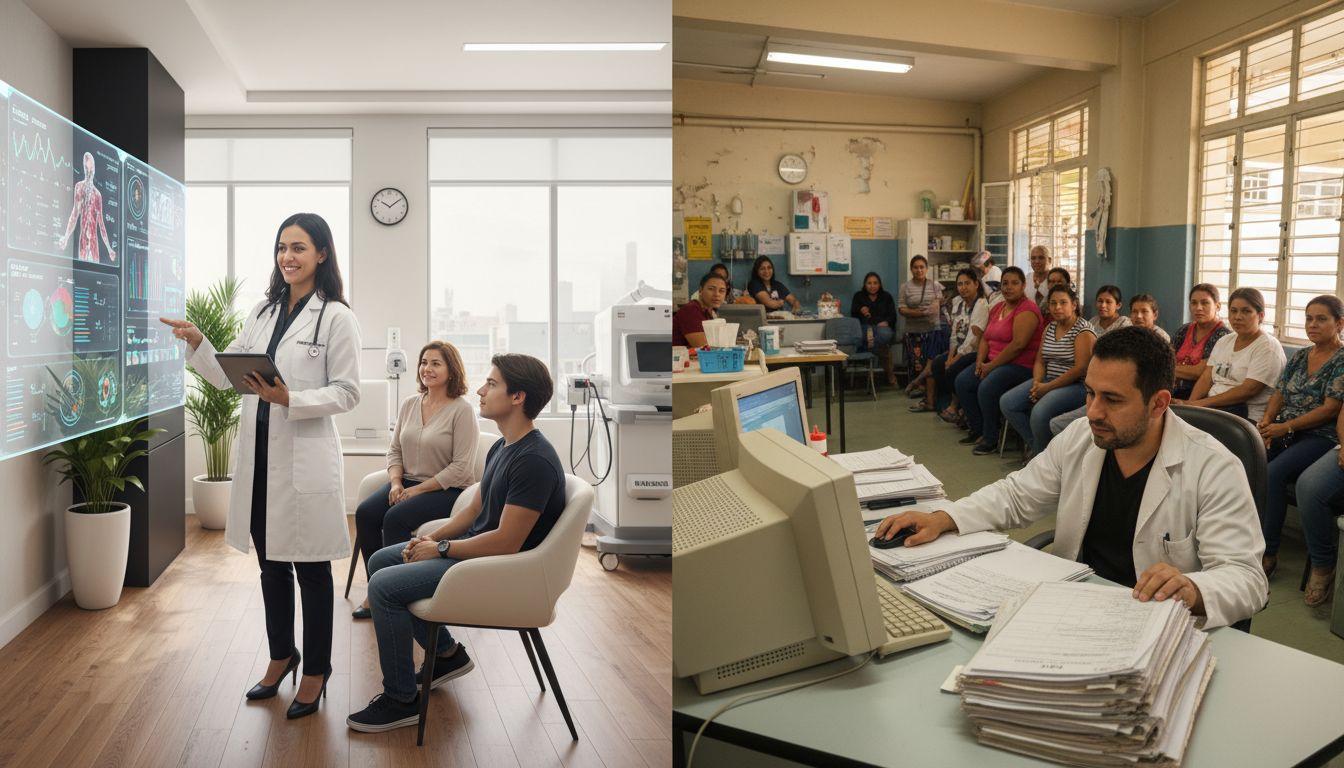
Did you know that private clinics can triple the speed of artificial intelligence adoption compared to public hospitals? This difference marks not only the speed of medical advancement, but also the quality of care each patient receives. Understanding how resources, implementation, and training influence this process helps identify why some institutions manage to innovate more and achieve better clinical outcomes.
Table of Contents
- 1. Access to AI technology: resources and limitations
- 2. Implementation of AI in daily clinical workflows
- 3. Impact on medical decision-making
- 4. Patient data security and privacy
- 5. Costs and barriers to the adoption of medical AI
- 6. Staff training in public and private environments
- 7. Clinical outcomes: efficiency and quality of care
Quick Summary
| Decision Making | Explanation |
|---|---|
| 1. Private clinics have better access to AI | The availability of financial resources allows private clinics to implement more advanced and useful AI technologies. |
| 2. Public hospitals face significant limitations | The lack of budget and technological resources restricts the adoption of AI in public hospitals, affecting their medical care. |
| 3. Continuous training is essential | Staff training in the use of AI determines its effectiveness; private clinics tend to offer more personalized and dynamic programs. |
| 4. AI does not replace the doctor | Technology acts as a complement to clinical judgment, improving diagnostic accuracy and response times without replacing the professional. |
| 5. Data security is crucial | Institutions must establish robust security protocols to protect sensitive patient information in digital environments. |
1. Access to AI technology: resources and limitations
Artificial intelligence technology in medicine represents a field of enormous possibilities, but with profound differences in its implementation between private clinics and public hospitals. Disparities in technological access they mark a significant gap that directly impacts the quality of medical care.
In private clinics, the technological landscape tends to be more promising. These institutions generally have greater financial resources to invest in cutting-edge AI solutions. They can acquire advanced diagnostic systems, predictive analytics tools, and machine learning platforms that significantly improve diagnostic accuracy.
Conversely, public hospitals face budget constraints that restrict their ability to implement state-of-the-art AI technologies. Investment in technological infrastructure competes with urgent needs such as basic medical equipment, personnel, and medications.
The differences are evident in crucial aspects:
- Implementation speed of new technologies
- Quality of AI systems available
- Depth of diagnostic analysis what they can do
This reality does not mean that public hospitals are completely excluded. Many public institutions establish strategic alliances with universities or government programs to access innovative technological solutions. Exploring Artificial Intelligence in Medicine: Transforming Tomorrow's Healthcare offers a deeper perspective on these technological adaptation strategies.
For medical professionals, understanding these limitations is essential. It is not just about having access to technology, but about using it efficiently and ethically, maximizing its potential to improve health outcomes regardless of the institutional context.
2. AI implementation in daily clinical workflows
The incorporation of artificial intelligence into clinical workflows represents a radical transformation in daily medical practice. Each healthcare institution faces unique challenges when integrating these technologies, generating substantial differences between private clinics and public hospitals.
In private clinics, AI implementation is usually more agile and personalized. Professionals can quickly adapt technological tools to their specific processes, optimizing tasks such as note generation, file analysis, and diagnostic decision-making.
Public hospitals, by contrast, face a more complex implementation. Process standardization, budget constraints, and more rigid bureaucratic systems slow down the adoption of AI solutions. This means that traditional clinical workflows remain less automated and more dependent on manual labor.
The main differences in implementation include:
- Integration speed technological
- Flexibility to customize tools
- Automation Level of administrative processes
- Adaptability of the systems
Critical aspects of implementation they imply not only acquiring technology, but also culturally transforming medical teams. Upload clinical files and let them integrate into your notes automatically it can be a first step to understand this transition.
For medical professionals, the challenge is not to replace clinical judgment, but to enhance it through tools that free up time for more human and personalized care. AI does not replace the doctor; it empowers them to make more informed and precise decisions.
3. Impact on medical decision-making
Artificial intelligence is radically transforming the medical decision-making process, generating profound differences between private clinics and public hospitals. Each institution experiences this technological revolution in a completely different way.
In private clinics, AI acts as a powerful decision-making ally. Doctors can access advanced diagnostic support systems that analyze symptoms, medical histories, and clinical data with extraordinary precision. These systems allow information to be cross-referenced instantly, significantly reducing the margin of error in complex diagnoses.
Public hospitals face a more constrained scenario. With more restricted technological resources, decision-making still relies heavily on the individual experience of the professional. The implementation of AI tools is slower and more fragmented, which generates significant disparities in the quality of diagnostic analysis.
The critical elements in this process include:
- Speed information processing
- Depth of the diagnostic analysis
- Accuracy in the identification of clinical patterns
- Capacity of integrating multiple sources of information
Understanding Differential Diagnosis: A Complete Guide for Health Professionals offers a deeper perspective on how technology is modifying these processes.
The true potential of AI in medical decisions does not lie in replacing the professional, but in enhancing their analytical capacity, allowing them to make more informed, faster, and more precise decisions. Technology thus becomes a fundamental complement to human clinical judgment.
4. Patient data security and privacy
Data protection in digital medical environments represents one of the most critical challenges in the era of artificial intelligence. Each healthcare institution faces unique challenges to ensure the confidentiality of sensitive patient information.
In private clinics, security systems tend to be more advanced and personalized. These institutions invest significantly in encryption technologies, restricted access, and cutting-edge security protocols that minimize the risks of leaks or unauthorized access.
Public hospitals experience greater complexities. With older technological infrastructures and limited resources, the implementation of robust digital security protocols becomes more complicated. According to recent research, techniques like the federated learning allow maintaining the privacy of electronic medical records while processing data in a distributed manner.
Crucial security aspects include:
- Access control sensory information
- Encryption levels of the data
- Traceability for queries and modifications
- Protocols recovery and backup
New in Itaca: build your patients' medical history automatically offers a perspective on how to manage these critical aspects.
The ultimate goal is not just to protect information, but to create technological ecosystems that guarantee confidentiality without hindering diagnostic efficiency and the necessary exchange of medical information.
5. Costs and barriers to the adoption of medical AI
The implementation of artificial intelligence in medical environments is not a simple process. It represents a complex investment that varies dramatically between private clinics and public hospitals, where resources and technological adoption strategies differ significantly.
In private clinics, the adoption of medical AI is usually more agile and direct. These centers have a greater financial capacity to make immediate technological investments, allowing them to acquire state-of-the-art AI systems without the budget restrictions typical of the public sector.
Public hospitals face a more challenging landscape. Budgetary limitations, extensive bureaucratic processes, and the need to justify every investment slow down technological adoption. Each decision requires multiple approvals and evaluations that can prolong technological modernization for years.
The main adoption barriers include:
- Costs of initial implementation
- Training of the medical staff
- Resistance to technological change
- Complexity of integration with existing systems
Prices Can you offer a more detailed perspective on investment models in medical technologies?.
The true challenge lies not only in acquiring technology, but in culturally transforming institutions to harness the potential of artificial intelligence in medical practice. Successful adoption requires a strategic vision that balances technological investment with the continuous improvement of care processes.
6. Staff training in public and private environments
The introduction of artificial intelligence in medicine demands a radical transformation in professional training. Technological training has become a critical differentiating element between private and public institutions.
In private clinics, training tends to be more dynamic and personalized. These institutions can invest in intensive training programs, specialized workshops, and continuous updating processes that allow professionals to adapt quickly to new technological tools. Physicians access specific training on AI systems, learning to integrate these technologies into their daily practice almost immediately.
Public hospitals present a more complex scenario. Training frequently depends on governmental programs, with slower and more standardized processes. Professionals face greater challenges to stay updated, due to structural rigidity and the limitation of resources allocated to technological training.
The fundamental training elements include:
- Management of digital tools
- Interpretation of AI results
- Integration of technological systems
- Update continuous professional development
Itaca: AI Assistant for Doctors offers perspectives on how professionals can adapt to these technological transformations.
The ultimate goal is not to replace medical knowledge, but to enhance it. True training consists of developing professionals capable of communicating efficiently with technology, keeping the human component as the central element of medical care.
7. Clinical outcomes: efficiency and quality of care
The implementation of artificial intelligence in medicine not only represents a technological advancement, but a fundamental transformation in the quality and efficiency of medical care. The differences between private clinics and public hospitals become especially evident in the final clinical outcomes.
In private clinics, AI enables an almost immediate optimization of care processes. Systems can process information faster, generate more precise diagnoses, and personalize treatments almost instantaneously. This translates into shorter response times, a lower probability of medical errors, and significantly more efficient care.
Public hospitals are experiencing a more gradual transformation. Technological and structural limitations lead to a more complex AI implementation, where the improvement in clinical outcomes depends on a progressive and careful integration of digital tools.
Critical aspects in clinical results include:
- Accuracy diagnostic
- Speed information processing
- Customization treatments
- Reduction of margins of error
Evidence at Your Fingertips: Clinical Answers Now with Citations show how technology can empower medical practice.
The ultimate goal is not to replace human medical judgment, but to enhance it. Artificial intelligence thus becomes an ally that amplifies diagnostic and treatment capacity, substantially improving patient outcomes.
This table summarizes the key aspects of implementing AI in healthcare, focusing on differences between private clinics and public hospitals.
| Appearance | Private Clinics | Public Hospitals |
|---|---|---|
| Technological Access | Greater investment in advanced AI, predictive tools available | Budgetary limitations, depend on strategic alliances |
| AI Implementation | Rapid integration, personalized, and automation of clinical processes | Slower implementation, reliance on manual processes |
| Decision Making | Advanced systems improve diagnostic accuracy | Resource-limited, based on individual experience |
| Security and Privacy | Advanced security systems with encryption and modern protocols | Older infrastructure, techniques like federated learning adopted |
| Costs and Adoption Barriers | Agile investment, financial capacity for rapid technological upgrades | Budgetary barriers, bureaucratic processes prolong adoption |
| Staff Training | Dynamic and continuous training, rapid adaptation to new tools | Reliance on standardized and governmental programs, slow updating |
| Clinical Results | More precise and personalized diagnoses, immediate improvement in efficiency | Gradual implementation, improvement depends on careful integration |
Optimize the integration of medical AI into your clinical practice
The article highlights the key differences between private clinics and public hospitals in the adoption and use of medical artificial intelligence. The main challenge is overcome technological, budgetary, and cultural barriers to implement solutions that truly boost efficiency and quality in patient diagnosis and management. If you feel that the AI integration process is complex or that documentation and analysis consume too much valuable time, you are not alone. Professionals are looking for tools that streamline the clinical workflow, improve data security, and support decision-making without losing the essential human dimension.
Itaca.ai offers solutions specially designed for these needs. With features such as automatic SOAP note generation, diagnostic support with reliable sources, and secure management of sensitive data, we can help you reduce administrative burden and optimize your medical practice without compromising privacy or quality. Discover how to transform your processes in public or private environments with the help of artificial intelligence developed for healthcare professionals.
New Features Archives - Itaca shows you the latest innovations we adapt for each clinical context. To learn more about how to successfully leverage these technologies, visit our Guides Archives - Itaca. Do not let current barriers stop the improvement of your healthcare. Start integrating smart solutions today by visiting Itaca.ai.

FAQ
What are the main differences in the implementation of medical AI between private clinics and public hospitals?
The main difference lies in the speed and flexibility of implementation. Private clinics tend to integrate AI more quickly, while public hospitals face more bureaucracy. Evaluate your work environment and plan a clear implementation strategy.
How does access to AI in private clinics compared to public hospitals affect the quality of medical care?
Access to high-quality AI in private clinics generally improves diagnostic accuracy and patient response. Public hospitals may face limitations that impact the quality of care. Analyze the specific needs of your institution to optimize the use of AI.
What associated costs are there with the adoption of AI in private clinics and public hospitals?
Implementation costs are significantly higher in private clinics due to their financial capacity. In public hospitals, costs involve bureaucracy and additional justifications. Conduct a cost study that considers every aspect of your adoption plan to adequately calculate the necessary investment.
What steps must public hospitals follow to train us in the use of medical AI?
Public hospitals must establish training programs based on minimum standards and offer frequent updates. Start a training plan that includes modules on the management of AI tools and their integration into clinical workflows.
How can clinical outcomes in public hospitals be improved through the use of AI?
The key is in the gradual implementation of AI tools to optimize care processes. It initiates the integration of AI in critical areas such as diagnostics and personalized treatments to positively impact clinical outcomes.
What crucial aspects should be considered when evaluating AI systems for a private clinic?
It is essential to evaluate the accuracy and speed of the systems being considered. Prioritize tools capable of offering rapid analysis and accurate results to enable efficient medical decisions. Conduct pilot tests to verify that the systems align with your clinical workflow needs.



Leave a Reply