



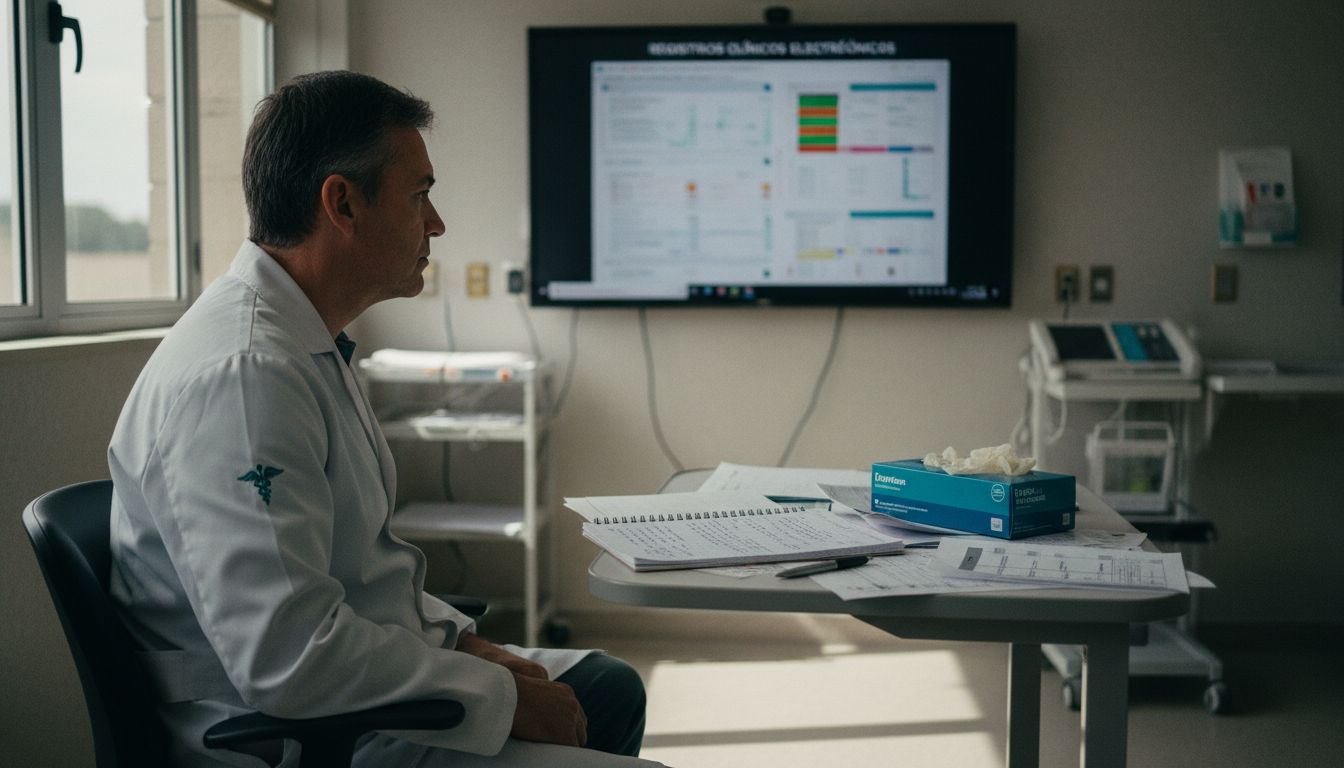
More than 40 percent of doctors' time is spent on administrative tasks in hospitals in Spain and Mexico. Frustration over documentation overload is common during any shift. Integrating medical data not only transforms access to information, but also enhances clinical accuracy and reduces errors. Here, you will understand how data integration optimizes daily practice and helps to regain focus on the patient.
Index
- Definition and essential concepts of medical data integration
- Main types and sources of integrated medical data
- Processes and technologies that facilitate clinical integration
- Legal requirements and international interoperability standards
- Privacy Risks and Common Integration Errors
- Real-world applications for optimizing medical documentation
Key Points
| Point | Details |
|---|---|
| Medical data integration | Transforming clinical practice by integrating diverse information to enable a personalized approach to medicine. |
| Data sources | Primary, secondary, and tertiary sources provide different levels of information, enriching the clinical context. |
| Integration Technologies | Implementing middleware, cloud storage, and artificial intelligence improves efficiency and accuracy in medical data management. |
| Regulations and Safety | Understanding international standards is crucial for maintaining interoperability and protecting sensitive patient data. |
Definition and essential concepts of medical data integration
The medical data integration represents a fundamental strategic process for transforming modern clinical practice, enabling the consolidation of diverse and heterogeneous information from multiple healthcare sources. This methodology seeks to unify clinical, molecular, and genetic data to facilitate a more personalized and precise approach to medicine.
Essentially, medical data integration involves systematically combining information from different systems and formats, such as electronic health records, genomic records, diagnostic test results, and radiological information. Advanced Biomedical Integration Techniques allow these disparate elements to be consolidated into a coherent repository that facilitates comprehensive analysis.
The main goal of this process is not merely to gather information, but to transform it into actionable knowledge. Through integration, healthcare professionals can gain a holistic view of the patient, identify complex patterns, predict potential risks, and design more precise treatment strategies. This approach drives the precision medicine, enabling personalized treatments based on each patient's molecular, genetic, and clinical profile.
Professional advice: Implement data integration systems that ensure interoperability among different technology platforms and comply with security and privacy protocols for medical information.
Main types and sources of integrated medical data
The integration of medical data encompasses a wide range of sources that provide crucial information for the diagnosis, treatment, and follow-up of patients. Detailed Classification of Medical Sources It helps us understand the diversity and complexity of the data that can be consolidated in health information systems.
The main types of medical data sources can be categorized into:
Primary sources: These include direct medical records such as electronic health records, consultation reports, diagnostic test results, medical images (X-rays, MRIs), and genomic data.
Secondary sources: These consist of reference databases, summaries of clinical research, meta-analyses, and compendia of medical information that synthesize findings from multiple studies.
Tertiary sources: Specialized textbooks, clinical practice guidelines, systematic reviews, and official protocols that provide interpretive frameworks and evidence-based recommendations.
Each type of source brings a unique perspective to the landscape of medical information. Primary sources offer direct, patient-specific data, while secondary and tertiary sources provide context, interpretation, and aggregated knowledge that enrich clinical understanding.

Here, we compare the three major sources of integrated medical data and their main contributions:
| Font type | Representative example | Clinical added value |
|---|---|---|
| Elementary school | Medical history | Patient-Specific Information |
| High school | Meta-analysis | Aggregated findings from studies |
| Tertiary | Clinical Guidelines | Recommendations and broad context |
Professional advice: Develop a critical evaluation system to verify the quality, relevance, and currency of each data source before integrating it into your medical repository.
Processes and technologies that facilitate clinical integration
Technological advances have radically transformed medical data integration processes, enabling a more efficient and accurate consolidation of health information. Biomedical Data Integration Architectures reveal sophisticated strategies for unifying different clinical information sources.
The main integration processes and technologies include:
Interoperability middlewarePlatforms that enable communication between different medical information systems, using standard protocols like HL7 FHIR and OpenEHR.
Cloud storageData management systems that facilitate secure, scalable, and accessible storage of medical information, enabling remote access and distributed analysis.
Standardization techniquesTools that convert data from different formats to a common model, ensuring information consistency and compatibility.
Artificial intelligenceMachine learning algorithms capable of processing, classifying, and extracting relevant information from large volumes of heterogeneous medical data.
The combination of these technologies makes it possible to create medical information ecosystems that are more dynamic, interconnected, and useful for clinical decision-making. The key lies in implementing solutions that not only collect data but also transform it into actionable knowledge.
The following summarizes key technologies and their benefits in medical data integration:
| Technology | Main benefit | Impact on Clinical Practice |
|---|---|---|
| Interoperability middleware | Interconnection between diverse systems | Reduces duplication and errors |
| Cloud storage | Secure Remote Access | Facilitates collaboration and analysis |
| AI and machine learning | Large-scale processing | Improve prediction and personalization |
Professional advice: Prioritize technology solutions that ensure the interoperability, security, and scalability of your medical data integration systems.
Legal requirements and international interoperability standards
Interoperability in health information systems is a complex challenge that requires a deep understanding of global legal and technical frameworks. International Standards for Digital Health They establish fundamental guidelines to ensure the security, confidentiality, and effectiveness of the exchange of medical data.
The main international interoperability standards include:
HL7 (Health Level Seven): A protocol that defines the formats for exchanging clinical information, enabling standardized communication between different electronic record systems.
FHIR (Fast Healthcare Interoperability Resources): A modern standard that facilitates the exchange of medical data through flexible, web-based digital resources.
DICOM (Digital Imaging and Communications in Medicine): An international standard for the handling and transmission of digital medical images, ensuring their compatibility across different devices and systems.
SNOMED CTStandardized clinical terminology that allows for precise and uniform coding of medical concepts internationally.
Each of these standards plays a specific role in building more integrated, secure, and efficient health information ecosystems. Adopting them involves not only meeting technical requirements but also ensuring the protection of sensitive data and facilitating more coordinated medical care.

Professional advice: Keep your knowledge of international standards up to date and conduct periodic audits to verify compliance with interoperability protocols at your institution.
Privacy Risks and Common Integration Errors
The integration of medical data presents critical challenges in terms of security and privacy that require meticulous attention. Data Protection in Healthcare Settings It highlights the complexity of safeguarding sensitive patient information in increasingly interconnected digital systems.
The main risks and common mistakes in medical data integration include:
Security vulnerabilities: Vulnerabilities that could allow unauthorized access, leaks of confidential information, or tampering with medical records.
Lack of informed consent: Failing to obtain explicit consent from patients for the use and sharing of their personal data.
Inconsistencies in Standardization: Differences in data formats that lead to incompatibilities and potential errors in the interpretation of the information.
Shortcomings in Access ControlSystems with weak protocols that do not guarantee robust authentication of professionals consulting the information.
Effective management of these risks requires a comprehensive approach that combines cutting-edge technology, strict security protocols, and an organizational culture committed to protecting sensitive data.
Professional advice: Implement a continuous audit system that periodically assesses vulnerabilities in your medical data integration processes and constantly updates your security protocols.
Real-world applications for optimizing medical documentation
Innovations in medical digitization they are radically transforming the way healthcare professionals manage and document clinical information, allowing for unprecedented optimization of administrative processes.
The most relevant applications for medical documentation optimization include:
Automatic transcription of queriesAI tools capable of converting medical conversations into structured and accurate clinical notes.
Instantaneous clinical summary generationSystems that automatically synthesize the relevant information from each query, facilitating quick and consistent documentation.
Multimedia Record IntegrationPlatforms that allow for the incorporation of diagnostic images, lab reports, and other multimedia documents into a single digital record.
Documentation completion assistantsAI algorithms that suggest add-ons and standardized formats to streamline the creation of medical reports.
These technologies not only reduce the administrative burden but also significantly improve the accuracy and traceability of medical information, allowing professionals to dedicate more time to direct patient care.
Professional advice: Progressively evaluate digital documentation tools, implementing them module by module and constantly training your team to maximize their potential.
Optimize medical data integration with Itaca to improve clinical efficiency
The integration of medical data is a challenge that demands intelligent solutions to consolidate clinical, genomic, and diagnostic information into accessible and reliable records. This process, essential for precision medicine, requires minimizing common errors such as lack of interoperability and ensuring the privacy of sensitive data. With Itaca, an AI-based clinical assistant, you can automate time-consuming tasks like transcribing consultations, generating structured clinical notes, and summarizing calls, thereby facilitating faster and higher-quality medical documentation.

Discover how Itaca adapts to your workflows without interrupting your medical practice and how it strengthens your clinical judgment with structured information and transparent evidence. Don't let data integration complexity hold you back. Explore our Guide files to obtain valuable resources, get to know the New features that streamline your processes and compare solutions in Product comparisons. Visit https://itaca.ai and take the next step towards more efficient and secure clinical management.
Frequently Asked Questions
What is medical data integration?
Medical data integration is a process that combines information from different healthcare sources, such as electronic health records and diagnostic test results, to improve care and personalize treatments.
What are the types of integrated medical data sources?
Medical data sources are classified as primary (medical records, test results), secondary (meta-analyses, research summaries), and tertiary (clinical guidelines, textbooks).
What technologies are used to facilitate clinical integration?
Various technologies are used as interoperability middleware, cloud storage, standardization techniques, and artificial intelligence to process and unify medical data.
What are the main risks associated with integrating medical data?
The main risks include security vulnerabilities, lack of informed patient consent, inconsistencies in data standardization, and deficiencies in access controls.



Leave a Reply