



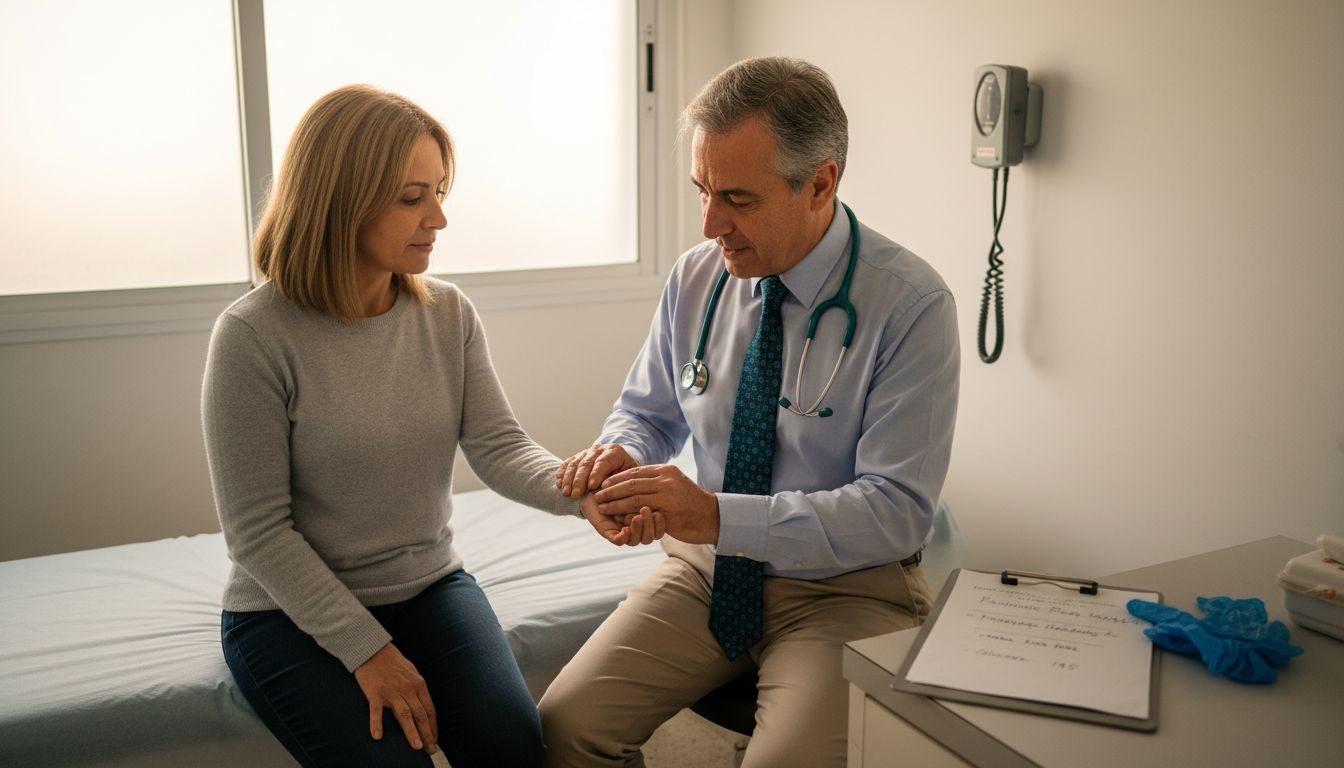
The endocrinological physical examination It is an exploration guided by the chief complaint: it combines vital signs and anthropometry with the evaluation of skin and skin appendages, neck and thyroid, eyes, body distribution, strength, reflexes, extremities, and other relevant findings. There is no identical sequence for all patients; the professional selects and documents what is relevant according to the history, age, treatment, and clinical hypothesis.
This guide offers a practical framework for evaluate, describe, and compare findings. Adapt it to the reason for consultation and your institution's protocol.
Content
- Endocrinological physical examination vs. endocrinological profile
- Systematic evaluation: what to review
- Frequent findings and how to document them
- Practical example of documentation
- Checklist before closing the note

Endocrinological physical examination vs. endocrinological profile
They are distinct components of the evaluation. The physical examination records what was observed or verified during the examination. A endocrinological profile it usually refers, generically, to laboratory tests selected to answer a clinical question. No single panel serves for all queries.
| Component | What it brings | How to document it |
|---|---|---|
| Medical history | Symptoms, evolution, treatment, medical history, and context | Separate what was reported by the patient from the confirmed data |
| Physical examination | Observed, measured, or palpated findings | Describe location, magnitude, laterality, and comparison when applicable |
| Laboratory or imaging | Additional data chosen according to the clinical question | Include value, unit, date, source, and relevant comparison |
| Evaluation | Professional interpretation of the ensemble | Explain which findings support, weaken, or leave a hypothesis open |
The American Diabetes Association Standards of Care, for example, dedicate a specific section to comprehensive medical evaluation and its comorbidities. In the note, separating history, physical exam, tests, and interpretation avoids turning a general list into an indiscriminate examination.
Systematic evaluation: what to review and record
Start with the problem you need to solve. A consultation for a thyroid disorder, weight changes, hirsutism, or metabolic follow-up does not require the exact same examination. The following sequence acts as a documentation map and must be adapted to the case.
1. General condition, vital signs, and anthropometry
- General appearance, alertness level, and observed effort tolerance.
- Blood pressure, heart rate, and other relevant vital signs.
- Weight, height, and body mass index when useful; record measurement conditions and changes compared to previous values.
- Waist circumference or other measurements only when indicated by the assessment and obtained using a consistent technique.
2. Skin, hair, nails, and hair distribution
- Color, moisture, texture, temperature, and relevant lesions.
- Striae, ecchymosis, acanthosis, edema, or changes in healing, if present.
- Distribution and changes of hair. When using a clinical scale, record which one you applied.
The guides of the Endocrine Society on hirsutism they exemplify why it is advisable to describe the finding and, when appropriate, use a recognizable score instead of simply writing “hirsutism present”.
3. Head, eyes, neck, and thyroid
- Ocular findings relevant to the chief complaint, including symmetry and observable changes.
- Neck inspection and swallowing when relevant.
- In thyroid palpation: apparent size, symmetry, consistency, tenderness, mobility, and palpable nodules, without turning the palpation into a diagnostic conclusion.
- Lymphadenopathy or other relevant cervical findings.
Specific recommendations depend on the thyroid problem. The American Thyroid Association maintains differentiated guidelines by condition and population; use the applicable guideline instead of extrapolating a single standard to all patients.
4. Cardiovascular system, neuromuscular system, and extremities
- Frequency and rhythm observed or auscultated, when part of the assessment.
- Tremor, proximal strength, gait, reflexes, or relevant functional changes.
- Edema, perfusion, and foot examination when the metabolic or neurological context warrants it.
5. Development and secondary sex characteristics
Evaluate these items only when clinically relevant, with appropriate explanation, privacy, and consent. Document the method or scale used, the developmental stage when applicable, and any limitations of the examination. Avoid making inferences about identity, behavior, or function from appearance.
Frequent findings: describe before interpreting
A physical finding rarely confirms an endocrine disorder on its own. Its value arises from its relationship with symptoms, clinical evolution, medications, other findings, and available studies.
| Finding | Useful description | Correlation that may require |
|---|---|---|
| Palpable thyroid change | Diffuse or focal, side, approximate size, consistency, tenderness, and mobility | History, evidence, or image according to applicable criteria and guidance |
| Weight change or body fat distribution | Magnitude, period, previous measurements, distribution, and functional changes | Intake, medication, edema, body composition, and metabolic context |
| Skin alteration | Type, location, extent, color, and date of appearance | Associated symptoms, exposure, medications, and non-endocrine causes |
| Hirsutism, hair loss, or acne | Pattern, progression, scale used, and accompanying signs | Menstrual or reproductive history when applicable, medications, and targeted evaluation |
| Tremor or proximal weakness | Laterality, intensity, triggers, and functional impact | Neurological examination, medications, and systemic context |
| Edema | Location, symmetry, extent, and characteristics | Cardiac, renal, hepatic, vascular, and medication causes, in addition to endocrine evaluation |
Also document relevant negativessought and unfound findings that help interpret the case. Avoid automated lists of “all normal”. If a maneuver was not performed or the exam was limited, record it explicitly.
Practical example of documentation
Practical example to show how information can be organized.
Context Follow-up consultation for a previously evaluated thyroid disorder. Patient reports symptom stability since the previous check-up and reports no recent medication changes.
Measurements blood pressure 118/72 mmHg; heart rate 76 bpm; weight 68.4 kg, compared to 68.9 kg at the previous visit.
Directed exploration: Neck without visible increase in volume. Thyroid mobile with swallowing, without evident asymmetry or palpable nodules on this examination. No observable postural tremor. Warm skin, without peripheral edema.
Limitations: The physical examination does not replace the review of available studies; the results and their date are documented separately.
Assessment and plan: professional synthesis based on evolution, exploration, and reviewed studies; behavior and next check-up recorded in their corresponding section.
Note that the example separates the referred, the measured, the explored, and the interpretation. To organize the rest of the query, see the guide of follow-up clinical history in endocrinology.
Endocrinological physical examination checklist
- Does the examination address the reason for consultation and the active hypotheses?
- Do vital signs and measurements include value, unit, and comparability?
- Do the findings describe location, laterality, magnitude, and evolution when applicable?
- Were relevant negatives recorded without copying a review that was not performed?
- Does the note distinguish physical findings, laboratory results, and clinical interpretation?
- Are the scales or techniques used identified?
- Were the limitations of the exam visible?
- Does the assessment avoid stating a diagnosis based on an isolated sign?
- Did the professional review and correct the record before adding it to the file?
Documentation errors that reduce the value of the exam
- normal endocrine exam it does not indicate what was explored nor does it allow comparing changes.
- Convert a finding into a diagnosis: describe first and reserve the interpretation for the evaluation.
- Mix results with exploration: A laboratory value is not a physical finding.
- Copy unchecked negatives: Record only what was evaluated.
- Omit the comparison: weight, neck, skin, or strength have more value when their evolution can be seen.
- Ignore alternative causes: Many signs are not exclusive to an endocrine disease.
Turn the exploration into a clear note
Itaca organizes the clinical conversation and the findings you confirm into a structured draft. You verify the measurements, correct the description, and approve the version that is incorporated into the record.
Frequently Asked Questions
What does an endocrinological physical examination include?
Include a general evaluation and elements directed by the reason for visit: vital signs and anthropometry, skin and appendages, neck and thyroid, eyes, body distribution, cardiovascular system, neuromuscular function, extremities, and, when applicable, secondary sexual development or characteristics. Not all components are performed in every visit.
Is the endocrinological profile the same as the physical examination?
No. The physical exam records observed, measured, or palpated findings. “Endocrinological profile” is usually used to refer to laboratory tests, which should be selected according to the clinical question. Both are interpreted together with the history and evolution.
How is a thyroid without palpable findings documented?
Describe what was evaluated and what was not found, without stating more than the examination allows. For example: “neck with no visible enlargement; thyroid mobile with swallowing, with no obvious asymmetry or palpable nodules on this examination.” Adapt the wording to the technique performed and the context.
What negative findings are advisable to record?
Only those that were sought and help interpret the reason for consultation. They may include the absence of observable tremor, edema, thyroid asymmetry, or specific skin changes, depending on the case. Avoid copying lists of negatives that were not evaluated.
Can an AI tool interpret the doctor's examination?
It can help organize what was said and confirmed findings into a draft, but it must not invent maneuvers, fill in missing results, or replace professional judgment. The physician reviews, corrects, and interprets the information before approving the note.




Leave a Reply